Exporting: how to sell abroad from Colombia
Exporting: how to sell abroad from Colombia
Exporting is not just selling farther away. It means meeting another country's rules, getting paid in another currency and carrying your cash flow for longer than a domestic sale. What breaks first is almost never customs: it is liquidity. This is the full route, from what Colombian law counts as an export to the money landing in your account, with documents, pricing, foreign-exchange settlement and an example that adds up.
What counts as an export and what does not
An export is the departure of goods or services from the national customs territory so that they are consumed or remain abroad. The deciding word is "remain": if the goods leave with a commitment to come back, the regime changes, and so do the documents.
Three figures get confused. A definitive export is a sale with no return. A temporary export covers goods that leave for repair, for an event, for processing or to return to production. Re-export applies to goods that entered under a special regime and leave without being nationalised.
Delivering to a foreign customer at your Bogotá warehouse is not an export either: that is a domestic sale, and your customer is the exporter. Sales to a free trade zone follow that regime, with its own benefits, but they are not a definitive export. And service exports — design, software, consulting — carry no goods export declaration: the contract, the invoice and the incoming payment are the support.
Exporter requirements: RUT, responsibilities and registration
There is no exporter card you file once and keep forever: there are conditions that must be in order before the first shipment.
The first is the RUT, the tax registry. The export activity must be reflected there, with the responsibility that corresponds under the codes the DIAN uses. A RUT that still says retail trade at a company that already exports is the most common cause of a rejected declaration.
The second is legal existence: a current chamber of commerce certificate, an identified legal representative and the corporate authority to bind the company. If someone who cannot sign signs, the problem shows up with the container already at the port.
The third depends on the product. Food, cosmetics, medicines, agricultural inputs, animals and plants need a sector approval before they leave. The list changes by tariff subheading: check the subheading and see which approvals apply.
The process: quote, contract, declare and ship
Order matters, because each step closes the one before.
- Quote with an explicit Incoterm, a short validity and a stated exchange-rate assumption. Without an Incoterm there is no quote, only an open argument.
- Contract with quantity, specification, packaging, date, payment terms, Incoterm and what happens if the lot is rejected at destination.
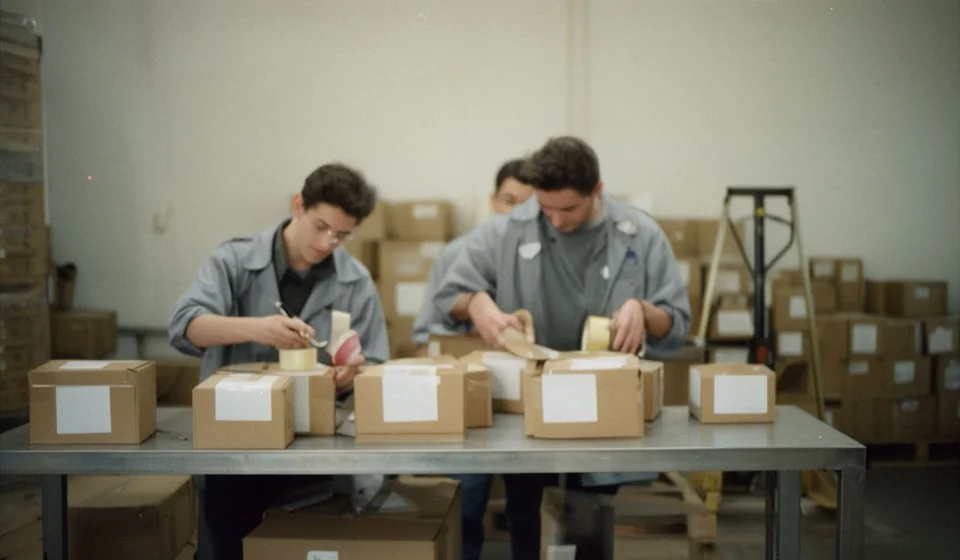
- Produce and pack for export: marking, strength and several container handlings, not domestic packaging.
- Book freight and insurance before shipment, with the cover the agreed Incoterm requires.
- Declare through the customs broker, with subheading, regime, value and settlement deadline. That deadline is recorded as an obligation.
- Clear customs under selectivity: automatic release, documentary inspection or physical inspection. With an inspection the schedule moves and the booked space is lost.
- Close with the final transport document, the certificate of origin if applicable and the complete file.
The most expensive sequencing error is declaring before confirming space on the vessel. The declaration expires and the vessel does not wait.
Transaction documents and the certificate of origin
| Document | Issued by | What it is for | When it is needed |
|---|---|---|---|
| Updated RUT | DIAN | Identifies the exporter | Always |
| Certificate of existence and representation | Chamber of commerce | Shows who may sign | To contract or open an account |
| Commercial invoice | Exporter | Basis of value and payment | Every shipment |
| Packing list | Exporter | Packages, weights and dimensions | Every shipment |
| Transport document | Carrier or shipping line | Proves the contract and delivery | Every shipment |
| Export declaration | Customs broker before the DIAN | Formalises the regime and settlement deadline | Before loading |
| Certificate of origin | Chamber of commerce or authorised body | Gives access to preferential duty | If an agreement is in force |
| Sanitary, phytosanitary or environmental approval | Sector authority | Authorises the goods to leave | Depending on subheading |
| Cargo insurance policy | Insurer | Covers loss or damage in transit | Depending on Incoterm |
| Mandate to the customs broker | Exporter | Authorises clearance work | Every transaction |
The certificate of origin is the document that lets the importer pay less duty when a trade agreement is in force with the destination country. The exporter does not issue it: the chamber of commerce or an authorised body does, under the agreement's rules of origin, and it requires proof that the product meets those rules.
Without the certificate the importer pays full duty, and that extra cost ends up in the price: the buyer absorbs it or you cut yours.
Destination requirements: standards, labelling and certifications
Colombian customs lets goods out; the destination decides whether they come in. Two different filters, and the second one is not visible from your office.
Three families recur. Tariff: what the importer pays on arrival and whether an agreement gives preference. Regulatory: whether the product may be sold there, under which standard, with which registration and which label. Commercial: what the buyer demands even when the law does not, such as quality certifications or plant audits.
| Requirement | When it applies | Who demands it | What happens if missing |
|---|---|---|---|
| Preferential duty with certificate of origin | If an agreement is in force | Destination customs | The importer pays full duty and pushes on price |
| Technical standard and mandatory marking | Depending on product and country | Regulator | Detention at customs or return |
| Labelling in the local language | Food, cosmetics, textiles, electrical goods | Health or consumer authority | Relabelling at your cost or rejection |
| Health registration or import licence | Food, medicines, agrochemicals | Destination health authority | Entry prohibited |
| Phytosanitary certificate | Plants, animals and derivatives | Agricultural authority in both countries | Quarantine, treatment or destruction |
| Packaging and waste rules | Markets with extended producer responsibility | Destination environmental authority | Fine or refused shipment |
| Private certifications: organic, food safety, chain of custody | When the buyer asks for them | Buyer and certifier | The sale does not close |
Labelling causes the most rejections and is the cheapest to fix in time: destination language, country of origin, net content, composition and instructions. A wrong label is not fixed at customs; it is fixed in a warehouse abroad at local cost. That check belongs before the quote, not after you win the order.
Export pricing: how to build it without giving margin away
An export price is not the domestic price converted into dollars: it is a stack of layers that do not exist at home, or that the customer pays there.
The base is full production cost: materials, labour, energy, depreciation and real scrap. On top sit five physical layers — export packaging, inland transport to the port, customs work, international freight and insurance — and three financial ones: broker commission, the cost of the money during the term you finance and a currency-risk premium.
That premium is not a whim: whoever quotes today and collects in 90 days has a margin exposed to any move in the peso. An explicit cushion is more honest than discovering the problem on payment day. If you would rather not carry the risk, you hedge it with the bank: that costs too, and it also goes into the price.
The classic mistake is quoting cost plus a percentage without looking at freight. In low value-per-kilo products — textiles, plastics, dry food — freight can exceed the margin. No price fixes that business: you change the product, the packaging or the mode.
A 2,000-unit order, number by number
The exercise uses round assumptions to show the mechanics. An order of 2,000 units, production cost of 90,000 pesos per unit and a selling price at destination of 60 dollars per unit.
- Total cost: 2,000 × 90,000 = 180,000,000.
- Revenue: 2,000 × 60 = USD 120,000. At a sample exchange rate of 4,000 pesos, 480,000,000.
- Export costs: freight 18,000,000, insurance 2,400,000, customs broker 1,800,000, packaging 6,000,000 and a broker commission of 3 % of revenue, 14,400,000. Total: 42,600,000.
- Profit before tax: 480,000,000 − 180,000,000 − 42,600,000 = 257,400,000, which is 53.6 % of revenue.
| Item | Calculation | Amount in pesos | % of revenue |
|---|---|---|---|
| Sales revenue | 2,000 × USD 60 × 4,000 | 480,000,000 | 100.0 % |
| Production cost | 2,000 × 90,000 | 180,000,000 | 37.5 % |
| Export packaging | Exercise assumption | 6,000,000 | 1.3 % |
| International freight | Exercise assumption | 18,000,000 | 3.8 % |
| Cargo insurance | Exercise assumption | 2,400,000 | 0.5 % |
| Customs broker | Exercise assumption | 1,800,000 | 0.4 % |
| Broker commission | 3 % × 480,000,000 | 14,400,000 | 3.0 % |
| Profit before tax | 480,000,000 − 222,600,000 | 257,400,000 | 53.6 % |
| Financing cost of the term | 70,000,000 at 1.8 % a month for 105 days | 4,410,000 | 0.9 % |
| Profit after financing cost | 257,400,000 − 4,410,000 | 252,990,000 | 52.7 % |
That 53.6 % is the number celebrated in the sales meeting. The one that matters is the other. With payment at 60 days from shipment and 45 days of materials advance of 70,000,000, the company finances 70,000,000 for about 105 days: at 1.8 % a month that is 4,410,000 which never appears in the margin.
And the currency move is still missing. If the peso appreciates 5 % between quote and payment, revenue drops to 456,000,000 and profit to 233,400,000. Nothing about the business changed: the day you collected changed.
Settling foreign exchange: the obligation everyone forgets
When the money arrives the transaction is not over: the currency side begins. Colombian rules require export proceeds to be channelled through the formal foreign-exchange market. It is not a best-practice recommendation: it is an obligation with a deadline, a declaration and a penalty.
The mechanism is this: the transaction declares a settlement deadline, the time in which payment is expected. When the money arrives it enters through an authorised foreign-exchange intermediary — a bank, a finance company or an exchange house — or through a duly registered compensation account, and it is reported in the exchange declaration with a reference to the export. That match is what gets reviewed.
The deadline is not a single number and is not worth memorising: it depends on the modality, on the term agreed with the buyer and on the rules in force. Verify the applicable one and, above all, honour the one written in your own export declaration, because that is the one compared. If the customer asks for more time, the amendment is filed before the deadline.
Failing to settle on time brings exchange penalties, requests for information and, in serious cases, investigations. And a less visible effect: your record, a risk the bank charges for later.
Two cases always come up: samples of no commercial value and donations create no settlement obligation because there is no payment; and a service export is channelled the same way, with the contract and invoice as support.
Currency risk and payment terms
Currency risk can be eliminated, reduced or simply acknowledged. Eliminating it is almost never free.
The cleanest is natural hedging: if part of your costs is in dollars — imported inputs, freight — that expense offsets part of the dollar revenue. The second is a forward, a contract with the bank that fixes today the rate at which you will exchange on payment day. The third is an option, which sets a ceiling without giving up the gain if the peso weakens, in exchange for a premium.
The fourth, the most used and the worst: doing nothing. It works until it fails, and when it fails it fails on the whole margin.
Payment terms are the other half. Collecting before producing is best for cash and hardest to get. An irrevocable, confirmed letter of credit protects the exporter who does not know the buyer, in exchange for fees and a strict process: one small discrepancy in the documents can void the payment. Documentary collection is cheaper and less safe. Open account, at 30, 60 or 90 days, is the most comfortable for the customer and the riskiest for you.
For long terms there are two tools: international factoring, which turns the invoice into cash today at a discount, and credit insurance, which covers non-payment. Neither is free, but both cost less than a portfolio that never gets paid.
Logistics and insurance
The Incoterm defines who pays what and where risk transfers. It is not a quoting formality: it is the clause that decides who answers when the container arrives with water inside.
The shorter the Incoterm for the seller, the less control and the fewer costs you carry. EXW leaves everything to the buyer and is usually a bad idea, because you lose control of packaging and clearance. FCA and FOB are the usual middle ground. CIF requires delivery with freight and insurance paid to the destination port, although risk transfers earlier: many people confuse "pays the insurance" with "carries the risk". DAP and DDP take the goods to the customer's door, and DDP includes duties and formalities at destination, which requires a legal presence there.
In insurance, cover matters more than price. Cargo policies are written on standard market clauses, and the difference between broad and restricted cover shows up in the odd claims: wetting, theft, delay, broken packaging. For perishable or high-value cargo, review the clause with the broker before loading.
Two details that cost money: volumetric weight, which in air freight makes light bulky products expensive, and free days at destination, because port delay is charged by the day.
Common mistakes
These repeat in real operations, with their symptom and their cost.
| Mistake | Symptom | Consequence | Fix |
|---|---|---|---|
| Quoting in pesos and shifting currency risk without saying so | The buyer compares and the price does not fit | The sale is lost or the margin is renegotiated | Quote in the payment currency with a visible assumption |
| Forgetting the certificate of origin | The importer claims preferential duty | Preference lost and the customer asks for a discount | File it before loading |
| Not checking destination labelling | The lot is held at customs | Relabelling abroad or return | Validate the label before producing |
| Selling on 90-day terms with no financing | Cash tightens and payroll slips | Expensive debt or a broken cash flow | Price in the financing cost or use factoring |
| Settling foreign exchange late | A request arrives from the exchange authority | Penalty, extra costs and stricter banks | Settlement calendar with an early alert |
| Packing as if it were a domestic sale | Goods arrive dented or badly stowed | Claim, replacement and freight paid twice | Packaging spec with a drop test |
None of them is fixed with goodwill, but with a written procedure, a checklist per shipment and someone who reviews it before the container leaves.
What this route does not solve
This text describes the mechanism, not your case. If the product is regulated, if the destination demands a certification you do not have, if it is the first order, or if the amount puts your cash at risk, get professional review before signing. An accountant with foreign-trade experience costs less than a rejected container.
There are also cases where exporting makes no sense: when the margin cannot carry the freight, when volume does not fill a container, or when the customer wants 90 days and there is no way to finance them. There the problem is not customs: it is cost structure.
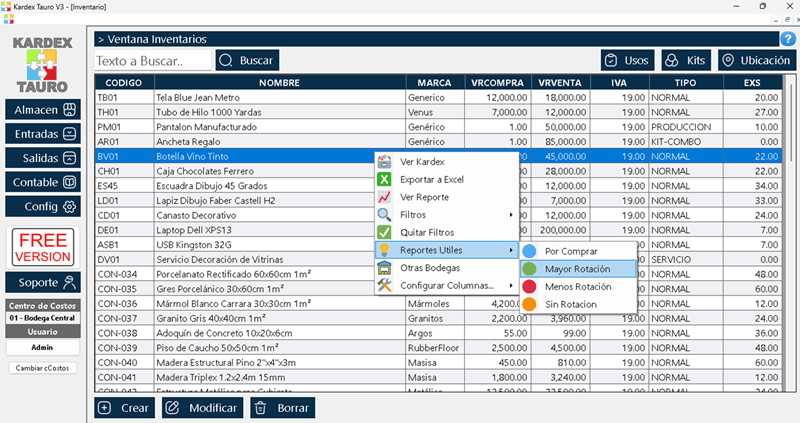
Exporting is won in the payment chain, not only in the price. An order with a 20 % margin collected in 30 days can leave more money than one at 40 % collected in 120. That is where an inventory and billing system stops being a filing cabinet: Kardex Tauro shows the real cost of the lot, the committed inventory and the receivables on the same screen where you decide whether the order is worth it.