VAT reconciliation: how to match the balance with your accounting records
VAT reconciliation: how to match the balance with your accounting records
The period closed and the accounting says there are 6,000,000 payable in VAT. The review against the documents says 6,285,000. Between the two numbers there is a credit note nobody recorded, a sale that was invoiced late and a purchase whose VAT was never deductible.
That 285,000 difference is not fixed by subtracting on instinct: it is fixed by finding the document that produces it. Here is the whole procedure, with the two accounts that make up the balance, the five items that explain almost every difference, the four steps of the reconciliation and an example that closes to the last peso.
Why accounting VAT and tax VAT drift apart
Accounting and the tax return do not pursue the same thing. Accounting orders economic events so the owner understands what happened; the return answers how much tax is due under a rule that defines the taxable event, the base, the accrual and the requirements of the supporting documents.
Four reasons for separation follow, and each one produces a type of difference:
- Time. Accounting may record a document in the month it arrives; the return places it in the period the document belongs to.
- Scope. Some VAT is paid and never deductible: in the books it is a higher cost or expense.
- Evidence. Tax invoiced without the legal requirements does not exist for the return, even if it exists in the ledger.
- Classification. A taxable, exempt or excluded transaction is recorded differently, and VAT takes a different path in each case.
So the two balances do not have to match. What they have to do is explain themselves. If you cannot name the item that produces the difference, you have not found the difference yet: you have found an error.
The two accounts: output VAT and input VAT
The VAT balance is not a single account going up and down. It is two, with opposite natures and separate ledgers, and the subtraction between them produces the result for the period.
Output VAT is born on every taxable sale and is recorded as a credit: it rises with sales and debit notes, and falls with credit notes and returns. Input VAT is born on every purchase with a right to deduct and is recorded as a debit; it falls with supplier credit notes and with VAT later found to be non-deductible.
The formula for the period: output VAT minus input VAT minus the VAT withholdings applied to you. If the result is positive there is tax payable; if it is negative there is a credit balance.
| Account | Nature | What it records | Warning sign |
|---|---|---|---|
| Output VAT on sales | Credit | Tax invoiced on taxable sales, plus debit notes, minus credit notes and returns | It grows while sales do not |
| Input VAT | Debit | Tax invoiced by suppliers with a right to deduct and tax paid on imports | It grows faster than the expense |
| Non-deductible VAT | Inside cost or expense | Tax paid that cannot be deducted: it goes to the cost of the good or to the expense | It stays in the VAT account out of neglect |
| VAT withheld from you | Credit balance | Tax a customer withheld and which is deducted from the amount payable | Withholding certificates that never appear |
| Payable or credit balance | Result | The subtraction of the accounts above at period close | It gets mixed with advances or other taxes |
With all VAT in a single account, on the day a difference appears nobody knows whether the problem is in what was sold or in what was bought.
Which documents feed each account
Output VAT is fed by documents you issue: electronic sales invoices, credit notes, debit notes and the equivalent documents the law allows when the transaction does not require an invoice. Input VAT is fed by documents you receive: supplier invoices and utility invoices, supplier credit notes, and imports with the tax paid.
Here is the point that explains half of the reconciliations that go wrong: the document has to show the tax separately. An invoice with VAT buried in the total, without the tax line, gives no right to deduct even if the money was paid. And a credit note without a reference to the invoice it corrects is a loose document: it is good for arguing, not for filing.
The timing is also confused: the VAT on a purchase does not become deductible because you paid it. On the accrual method the right arises when the transaction accrues; on the cash method, when it is paid.
Why the tax period is not the accounting month
The accounting close is monthly; the VAT period is not. In the general regime it is usually bimonthly, with exceptions and specific rules for withholdings: confirm your period and your due date, because the calendar changes every year.
The monthly close answers "how did we do"; the return answers "how much is due for these two months". If you take the June 30 balance as the base for a period ending July 31, you are missing a month of movement and the difference you find is not an error: it is a bad cut.
The cut is made by document date, not by payment date or receipt date. An invoice dated July 30 that arrived on August 3 belongs to the period that closed on July 31; if it is recorded in August, the reconciliation will show a difference that does not exist: the document is there, but in the wrong month.
The five items that explain almost every difference
In a Colombian small business almost every reconciliation is explained by five items. The amounts and the supplier names change; the nature of the difference is the same.
| Item | Why it appears | Effect on the balance | Treatment |
|---|---|---|---|
| Purchase with an invoice that fails the requirements | VAT was recorded as deductible without checking the document | Rises: input VAT falls | Remove it from input VAT and take it to cost or expense; if already filed, correct the return |
| Credit note issued and not recorded | Sales issued it and accounting received it after the close | Falls: output VAT falls | Record it in the period of issue, not the period of receipt |
| Goods delivered without an electronic invoice | It was shipped and the invoice was never transmitted | Rises: output VAT rises | Invoice it and report it in the period of the transaction |
| VAT with no right to deduct sitting in input VAT | All purchase VAT went into the same account | Rises: input VAT falls | Separate it by nature and move it to cost or expense |
| Accrual mismatch between document and entry | Records are made by payment date or receipt date | Rises or falls, depending on the case | Cut by document date and adjust the entry |
Two more items appear as the company grows: VAT withheld by a customer that nobody records, and a prior credit balance that is never offset. Both share the same symptom: the balance fails to match by an amount already settled in another document.
How to build the reconciliation in four steps
Step 1. Fix the accounting base. Take the ledger of the two accounts at the last day of the period, not the balance sheet total: the reconciliation is built from documents.
Step 2. Fix the tax base. Build the draft return from the documents: electronic invoicing, credit and debit notes, supplier invoices and imports.
Step 3. List the differences one by one. Each line carries a document, a date, an amount, the effect on the balance and a cause. "Sundry adjustment" is not an item: it is a difference nobody has investigated.
Step 4. Decide and sign. Each item is corrected in the accounting, corrected in the return, or documented for the next period. The working paper is signed and reviewed.
The opening example is solved with those columns. A VAT taxpayer closes with accounting output VAT of 18,000,000 and input VAT of 12,000,000: a balance of 6,000,000. Checking the supporting documents turns up three things.
First: a purchase of 2,000,000 with VAT of 380,000 whose invoice fails the requirements; input VAT for tax purposes drops to 11,620,000 and the balance rises to 6,380,000. Second: a credit note for 1,000,000 plus 190,000 of VAT, issued and not recorded; output VAT drops to 17,810,000 and the balance sits at 6,190,000. Third: a sale of 500,000 plus 95,000 of VAT delivered without an invoice, recognised before filing: output VAT rises to 17,905,000 and the balance ends at 6,285,000.
The tax balance is 17,905,000 minus 11,620,000, that is 6,285,000. The difference against the accounting is 6,285,000 minus 6,000,000: 285,000. It is built from a minus 190,000 for the credit note, a plus 95,000 for the sale and a plus 380,000 of VAT that stops being deductible. The three amounts add up exactly to the adjustment.
| Item | Output VAT | Input VAT | Balance payable |
|---|---|---|---|
| Accounting balance for the period | 18,000,000 | 12,000,000 | 6,000,000 |
| Purchase with a non-compliant invoice | — | -380,000 | +380,000 |
| Credit note not recorded | -190,000 | — | -190,000 |
| Sale delivered without an invoice | +95,000 | — | +95,000 |
| Tax balance | 17,905,000 | 11,620,000 | 6,285,000 |
| Adjustment to record in the books | — | — | 285,000 |
The VAT on that purchase does not disappear: it leaves the deductible account and enters the expense. Those 380,000 stop reducing tax and start reducing profit; that is why the accounting needs two entries and the return only one.
Adjustments: when to correct the books and when the return
The decision has an order: first the fact is established, then it is decided where it gets fixed.
If the tax determined is right and the error is in the entry, the books are corrected. That is the case in the example: the return is filed with 17,905,000 and 11,620,000, and the accounting is adjusted by 285,000. There is nothing to correct before the tax authority.
If the tax determined is wrong, the return is corrected. That happens when VAT that did not belong there was included, an operation of the period was omitted, or the return was filed for the wrong two-month period. The books are adjusted afterwards, so they reflect what was filed.
If the document belongs to a later period, there is no correction: there is a record in the period it belongs to. A credit note issued in August does not correct the June return; it enters the period in which it was issued.
Correcting a return involves a procedure and may carry a penalty and interest; check the rules in force for each year. And one hygiene rule prevents almost all of these cases: the return is not tuned to match the accounting, it is corrected when the tax fact was wrongly determined.
Payable balance, credit balance and credit pending offset
They are three results of the same calculation and they get confused because two of them look alike on the balance sheet.
The payable balance appears when output VAT exceeds input VAT plus withholdings. The credit balance appears when input VAT and withholdings exceed output VAT: it happens in months of heavy purchasing, in exports and at the start of operations. The credit pending offset is the part of an earlier credit balance not yet applied in a following return. It is not a new balance: it is the same one, only older.
The classic mistake is netting the credit balance against the payable balance on the balance sheet without recording the movement. The following period the account shows a balance no document explains, and the reconciliation starts with a ghost item nobody can trace.
A credit balance has two destinations: applying it in later periods or requesting a refund or offset. Until one of the two happens it is an idle asset: it earns nothing and it can lose validity. A balance three periods old is not an accounting problem: it is a pending decision.
How to control it month by month
Reconciliation is not done once a year or when the audit arrives: it is done every month, even when the return is bimonthly. One month without reconciling turns the review of the period into archaeology.
- Close the two accounts on the last day of the month, with the ledger exported and archived.
- Download the electronic invoicing report for the same cut-off.
- Compare accounting output VAT against what was invoiced in the period.
- Compare accounting input VAT against invoices received with a right to deduct.
- Note every difference with its document, amount and cause, in a file that is kept.
- Review the age of the items still open from the previous month.
Three numbers are enough as an indicator: how many items are open, what they add up to and how many periods the oldest one has been open. If they grow month after month, the problem is not the reconciliation: it is the recording, and the reconciliation is only showing it.
One rule that works: no item lives more than one period without a documented cause. Either it is corrected or it is explained in writing. The ones left for later are the ones that show up three years on in a request, with nobody who remembers what they were about.
How to prove each item when a review arrives
A reconciliation is worth not for what it says but for what can be rebuilt. The proof of an item is the set of documents that lets another person reach the same number without asking anything.
For a purchase: the invoice with the tax line, the goods receipt and the accounting entry. For a credit note: the reason, the invoice it corrects and the record of issue. For a sale: the transmitted electronic invoice and the delivery note.
Order matters: evidence is gathered when the event happens, not when the review arrives. A document rebuilt three years later looks too much like an invented one.
And there is a third source many ignore: electronic invoicing. What you reported and what the system recorded must agree; when they do not, the difference exists for the tax authority even if your accounting is spotless, and the job then is not to explain it: it is to correct it.
Frequent mistakes
These are not beginner mistakes: they appear in companies with an accountant, with software and with years of history, almost always because of haste at close.
| Mistake | Symptom | Consequence | Correction |
|---|---|---|---|
| Filing on the accounting balance without checking documents | The return matches the books and not the documents | The difference surfaces in the review, with penalty and interest | Reconcile before filing, with a signed working paper |
| Treating VAT on non-compliant invoices as deductible | Input VAT grows faster than the expense | More tax payable and a penalty on the improper VAT | Check requirements before recording; move the VAT to expense |
| Not recording credit notes in the period they are issued | Output VAT is inflated against net invoicing | Tax is paid on cancelled sales | Record at issue date; if already filed, assess a correction |
| Leaving credit balances unapplied for years | An account with a growing credit and no movement | Money frozen and risk of losing validity | A calendar for offsetting or for a refund request |
| Correcting the return when the error was in the accounting | Repeated corrections that never change the tax | An inconsistent file and avoidable penalties | Establish the fact before deciding where to correct |
An honest closing before you decide
VAT reconciliation is not a subtraction: it is a review of supporting documents. Any program does the subtraction. What prevents the problem is the person who opens the invoice and checks whether the tax could be deducted, and the one who records the credit note the day it is issued.
This does not apply the same way to everyone. If your company is in the simple regime, deductible VAT does not work the same way and the reconciliation follows other rules: confirm it with your accountant before copying this format. If you buy little, the reconciliation will be short; if you import, export or sell to entities that withhold, you will need more columns.
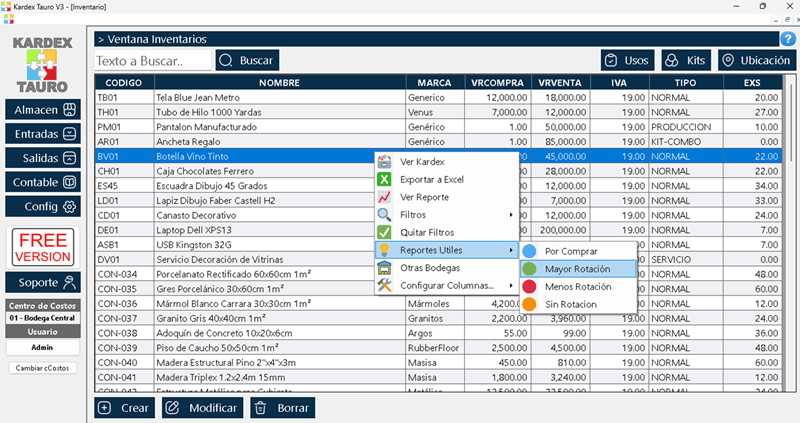
And it does not replace the accountant: it hands him, and you, the working paper that answers the questions before the authority asks them. If invoicing and inventory live in Kardex Tauro, the VAT report per period is built from the same documents that feed the accounting, and the reconciliation starts with fewer items to explain.