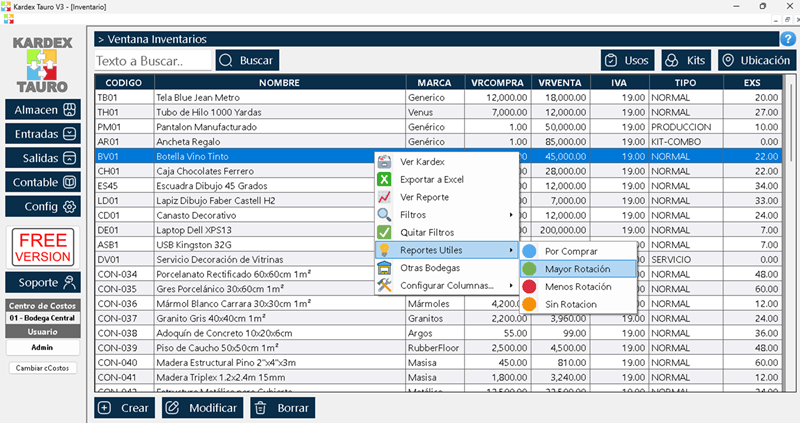
Inventory examples
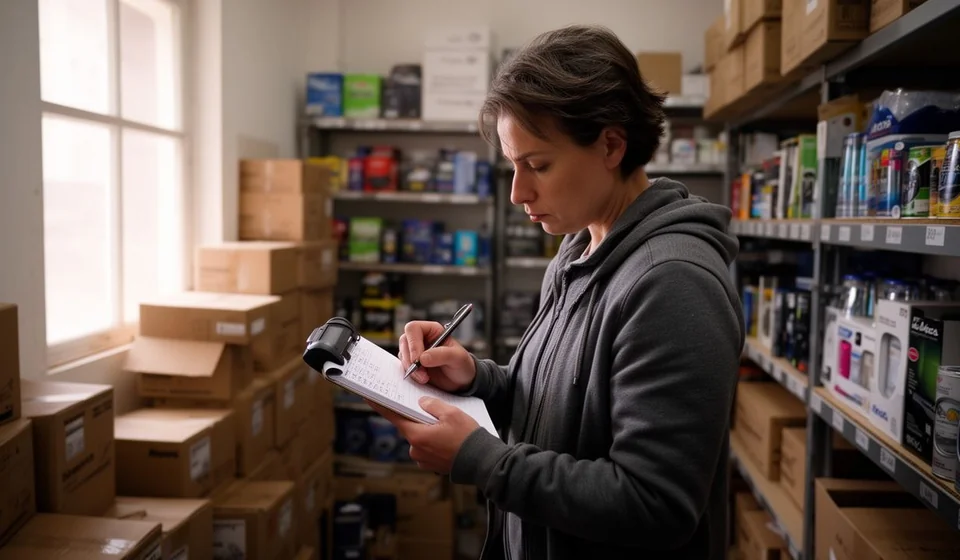
Inventory examples
If you run a business, sooner or later you will need to answer three questions: what products do I have, how many of each do I have, and how much is everything worth? The tool that answers these questions is the inventory. The best way to understand it is to look at real inventory examples from different types of business, because every store organizes and controls its stock in its own way.
Below you will find inventory examples for a clothing store, a supermarket or corner store, a hardware store, a pharmacy, a restaurant, and a stationery shop, together with a comparison table, the types of inventory by nature, and a sample inventory table you can use as a model in your own business.
What an inventory is and what it is for
An inventory is a detailed, valued list of everything a business has in stock at a given moment. It is not just writing down product names: a complete inventory shows which products are on hand, in what quantity, in what unit they are managed (unit, box, kilogram, liter, meter), where they are stored, and what they are worth, based on their purchase or production cost.
For example, noting that there are shirts in the storeroom is not a useful inventory; a real inventory must state how many shirts there are, their model, their color, their sizes, and the cost of each one. That is how you can calculate how much money is tied up in merchandise, detect shortages or surpluses, identify products that do not sell, and decide what to buy. In short, the inventory is the starting point for controlling your business and avoiding losses.
Inventory examples by type of business
Here are six inventory examples with the features that are typical of each business.
Clothing store. In a clothing store, inventory is organized by reference, color, and size, because the same garment can have several versions: a white shirt in size S is not the same product as the same shirt in size L. A concrete example: the inventory shows 120 pairs of jeans, broken down into 40 units of reference JN-201 in size 30, 45 in size 32, and 35 in size 34. If each pair costs $45,000, the total value of this reference is $5,400,000. In this type of business, inventory is counted more often at the start of each season, when the new collections arrive and the previous season's garments leave the shelves.
Supermarket or corner store. Here the inventory can easily exceed thousands of products, from grains and canned goods to beverages and cleaning supplies. Control is done by sections: for example, in the dairy section, milk, cheese, and yogurt are counted while checking their expiration dates, because an expired product on the shelf is a direct loss. A periodic count helps detect shrinkage, meaning products that were damaged, expired, or lost, and correct the records so the quantities on paper match the ones actually on the shelf.
Hardware store. A hardware store combines products counted by unit, such as hammers and drills, with products handled by weight or by box, such as screws, nails, and washers. For example, if the records show 40 boxes of one-inch screws but the physical count finds only 36, there is a difference of 4 boxes that must be investigated. For this reason, small items should be counted frequently in a hardware store, since they are the easiest to lose or to take without being recorded.
Pharmacy. In a pharmacy the inventory has an extra feature: every medicine must be recorded with its batch number and its expiration date. For example, a cough syrup may have several batches that expire in different months, and the pharmacy must sell the oldest batch first to avoid expired stock. In addition, some products are regulated and require stricter records of their ins and outs. A good inventory at the pharmacy prevents two costly problems: running out of a medicine that customers ask for, and having to discard expired products that represent lost money.
Restaurant. A restaurant inventory is almost always made up of perishable raw materials: vegetables, meats, dairy products, flour, and sauces that are turned into the dishes on the menu. For example, Monday's kitchen inventory records 8 kilograms of tomatoes, 5 of onions, and 12 of rice; with that information, the cook knows how many days the stock will last and what must be ordered from the supplier. Because food expires quickly, the FIFO method (first in, first out) is applied, which means using the oldest stock first. Counting the pantry every week prevents overbuying and losing money to waste.
Stationery shop. A stationery shop handles many low-value but high-volume products: notebooks, pens, pencils, reams of paper, folders, and inks. Inventory is therefore organized by product code and controlled with minimum and maximum levels. For example, if the rule says that when 20 notebooks are left a batch of 100 must be ordered, the shop will never run out of its best-selling item nor fill the stockroom with products that do not move. The challenge in this business is not valuing each pencil, but quickly knowing which product is about to run out.
Comparison table: inventory example by business
The following table summarizes the typical products and how stock is controlled in each type of business.
| Business type | Typical products | How stock is controlled |
|---|---|---|
| Clothing store | Shirts, jeans, dresses, jackets, shoes, and accessories | By reference, color, and size; seasonal counts |
| Supermarket and corner store | Packaged food, beverages, grains, dairy products, and cleaning supplies | Counts by section; expiration and shrinkage control |
| Hardware store | Tools, fasteners, paints, pipes, and building materials | By unit, weight, or measure; frequent counts of small items |
| Pharmacy | Medicines, cosmetics, vitamins, and personal care products | By batch and expiration date; reorders based on turnover |
| Restaurant | Vegetables, meats, dairy products, flour, and sauces (raw materials) | Daily or weekly kitchen counts; FIFO method |
| Stationery shop | Notebooks, pens, pencils, paper, folders, and inks | By product code; minimum and maximum reorder levels |
Types of inventory by nature, with examples
Another way to look at inventory is by the stage the product is in within the business. To explain it with an example, let us use a wooden furniture factory:
- Raw materials: the inputs that have not been transformed yet. In the furniture factory, the raw materials inventory includes wooden boards, varnish, screws, and glue. A business should know, for example, that it has 200 pine boards left, enough to make 50 tables.
- Work in process: products that are halfway done, already worked on but not yet ready for sale. In the example, these would be the boards already cut, the sanded pieces, or the chairs assembled but not yet varnished.
- Finished goods: products that are ready to be sold. In the factory, the tables and chairs that are finished, packed, and available to the customer make up the finished goods inventory.
- Merchandise: products bought to be resold without any transformation. In a clothing store, everything on the racks is exactly that: merchandise. If the furniture factory also sold cushions or lamps purchased from other suppliers, those purchases would also be merchandise for resale.
These four types can coexist in the same company: a factory controls raw materials, work in process, and finished goods, while a store, a supermarket, or a pharmacy works mainly with merchandise. Identifying which type of inventory your business works with helps you define what data to record and how often to count.
Example of an inventory table
To be useful, an inventory must be valued: every product must have its unit cost and its total value, which is calculated by multiplying the quantity by the unit cost. Here is an example of what a section of a corner store inventory looks like:
| Code | Product | Unit | Quantity | Unit cost | Total value |
|---|---|---|---|---|---|
| GR-001 | White rice, 1 kg | Pack | 120 | $4,200 | $504,000 |
| AC-002 | Vegetable oil, 1 L | Bottle | 60 | $9,800 | $588,000 |
| CF-003 | Ground coffee, 250 g | Pack | 45 | $8,500 | $382,500 |
| JA-004 | Bath soap | Unit | 90 | $2,300 | $207,000 |
| LE-005 | Whole milk, 1 L | Box | 150 | $3,900 | $585,000 |
| Total inventory value | $2,266,500 | ||||
Notice two details: each row corresponds to a product with a unique code, and the total value in the last column comes from multiplying the quantity by the unit cost. For example, 120 packs of rice at $4,200 each are worth $504,000. The sum of all total values ($2,266,500) is the value of the inventory, a key figure for knowing the capital invested in merchandise.
How to put these examples into practice
Putting an inventory into practice does not require expensive equipment; it requires order and consistency. These are the basic steps:
- Define the product catalog with a unique code for each reference, including variations such as size or color.
- Physically count the stock and write down the real quantities you find in the storeroom or at the point of sale.
- Record the unit cost of each product and calculate the total value of each line to have a valued inventory.
- Compare the result with the records of ins and outs (the stock card) to find differences in time.
- Repeat the count periodically and run cycle counts of the most important products during the month.
As the examples show, a well-kept inventory reduces losses, prevents running out of products, and lets you know how much money is invested in stock. If you want to put these examples into practice without complications, Kardex Tauro lets you record your products and movements, control your stock, and value your inventory online from any device.