How to make a kardex?
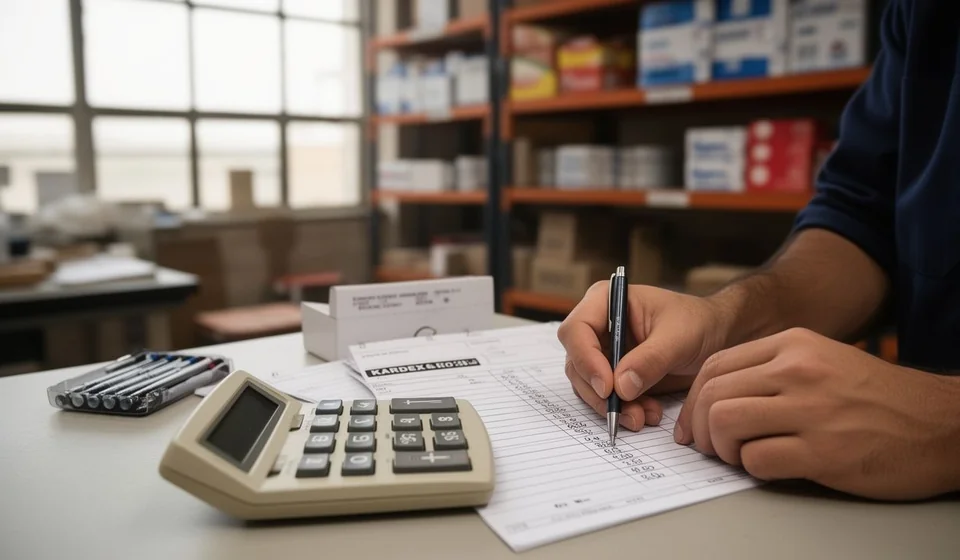
How to make a kardex?
Wondering how many units of a product you have left, what they cost, or how much your whole inventory is worth today is a constant question in any business. The kardex is the answer: a record sheet where you log, movement by movement, everything that comes into and goes out of each product, with its quantity and its value. Doing it well does not require being an accountant or mastering complicated software: it only takes order, clear data, and a simple method. In this guide we show you how to make a kardex from scratch, step by step, with a complete example and verifiable math that you can replicate in your own business.What you need to make a kardex from scratch
Before you write down the first movement, gather these four things:- The data of each product: code, description, unit of measure, and location inside the warehouse.
- Supporting documents: purchase invoices, delivery notes, sales receipts, and records of shrinkage or adjustments.
- A kardex format: a ruled sheet, a notebook, or a spreadsheet with the right columns.
- A defined costing method: weighted average, FIFO, or LIFO, decided from the start so that everyone calculates the same way.
Step 1: define the product data
Each kardex belongs to a single product, not to several. Before opening the sheet, define its basic data and write it in the header:- Code: a unique identifier, such as BOL-001, so that similar products are never confused.
- Description: the exact product name, for example black fine-point ballpoint pen.
- Unit of measure: piece, box, kilogram, liter, or meter, depending on how you buy and how you sell.
- Location: aisle, shelf, or warehouse area where the product is stored, essential for the physical count.
Step 2: choose the columns of the kardex
The structure of the kardex is what lets you record movements while knowing balances and values at the same time. These are the minimum columns needed to build a complete kardex:- Date: the day the movement happens.
- Document number: the invoice, delivery note, or receipt that supports the transaction.
- Concept: the reason for the movement: purchase, sale, return, shrinkage, or adjustment.
- In: the units that come into the inventory.
- Out: the units that leave the inventory.
- Balance: the available stock after each movement.
- Unit cost: the cost of each unit according to the costing method you chose.
- Value: the result of multiplying the balance by the unit cost, that is, how much the inventory of that product is worth.
Step 3: record the opening balance
The first row of the kardex is the stock with which the control begins. It is recorded as an initial entry, with the start date, the concept opening balance, and the quantity that came out of the physical count of that day. The unit cost must be the real cost of the merchandise: the last purchase price or the average calculated from your recent invoices. If this first value is wrong, every later calculation will carry the error.Step 4: record every entry and every exit
From that moment on, the kardex is fed with all the movements of the product, in chronological order and one per row. The golden rule is simple: no entry without a supporting document, and no document without its entry.- Entries: purchases from suppliers, goods receipts, customer returns, and surpluses found during counts.
- Exits: sales, internal consumption, returns to suppliers, shrinkage, damage, or losses.
Step 5: calculate the balance and the cost of each movement
After recording each row, the new balance is calculated with a simple formula: new balance = previous balance + entries - exits. The next row always starts from the previous balance; if the result ever turns negative, there is an error that must be fixed before continuing.The unit cost with the weighted average method
The weighted average is the costing method most used by small businesses because it is easy to understand and to apply. The idea is that every time merchandise comes in at a different cost, the whole inventory is valued with a recalculated average cost. It works in three steps:- Multiply the units of the previous balance by their unit cost to get the current value of the inventory.
- Add the value of the new entry, which is calculated by multiplying the received units by their purchase price.
- Divide the total value by the total units: that is the new average unit cost.
Complete example: the kardex of one product in a month
Below you have the kardex of the product black fine-point ballpoint pen, code BOL-001, sold by unit, during the month of February. The opening balance was counted on the 1st, and each row is a movement backed by its document:| Date | Doc. number | Concept | In | Out | Balance | Unit cost | Inventory value |
|---|---|---|---|---|---|---|---|
| Feb 1 | — | Opening balance | 100 | — | 100 | $500 | $50,000 |
| Feb 4 | C-1201 | Purchase | 50 | — | 150 | $520 | $78,000 |
| Feb 8 | V-301 | Sale | — | 60 | 90 | $520 | $46,800 |
| Feb 12 | C-1202 | Purchase | 30 | — | 120 | $530 | $63,600 |
| Feb 15 | V-302 | Sale | — | 70 | 50 | $530 | $26,500 |
| Feb 19 | C-1203 | Purchase | 50 | — | 100 | $539 | $53,900 |
| Feb 22 | V-303 | Sale | — | 40 | 60 | $539 | $32,340 |
| Feb 25 | A-004 | Shrinkage adjustment | — | 2 | 58 | $539 | $31,262 |
Step 6: compare the kardex with the physical count
The kardex is a record, not a certainty: what is written must match what is really on the shelf. That is why the control is closed with periodic physical counts: monthly for the fastest-moving products and a general count at least every quarter or semester. When you find a difference between the paper and reality, follow this sequence:- Count again to rule out a counting error.
- Review the documents of the period: a sale, a receipt, or an adjustment may be missing.
- If the shortage is real, record it as an exit due to shrinkage and note who is responsible.
- If the surplus is real, record it as an adjustment entry.
Common mistakes when making a kardex
- Recording from memory: writing movements without the invoice or delivery note at hand is the number one cause of wrong balances.
- Mixing units: recording sometimes in boxes and sometimes in pieces breaks every calculation; define a single unit of measure and do not change it.
- Recording entries without cost: a purchase without a unit cost makes it impossible to calculate the average and the inventory value.
- Not recalculating the average: keeping the previous cost after a purchase at a different price distorts the results.
- Hiding shrinkage: not recording losses, damage, or theft makes the kardex show stock that does not really exist.
- Recording out of order: skipping dates or registering days later turns the sheet into a reconstruction full of gaps.
- Ignoring negative balances: if the kardex shows less than zero units, something is wrong: you never sell what you do not have.
- Leaving the kardex for the end of the month: a record made late loses its purpose, because it no longer helps decide purchases or detect shortages in time.