Customer credit policy: how to set it without losing sales

Customer credit policy: how to set it without losing sales
A small business that sells on credit with no written rules is not selling: it is lending money interest-free to people it has not checked. A credit policy fixes that with a short document that states who gets a credit limit, for how much, on what terms, with which paperwork and what happens when they do not pay. Here it is built piece by piece, with an example that adds up.
What a credit policy is and what it must decide
A credit policy is a two- or three-page document that answers five questions before the first delinquent customer shows up: who is sold on credit, with how much of a limit, at what term, with which paperwork and what is done if they do not pay. It is the operating manual for receivables, and it applies the same way to a new customer worth two million pesos as to one worth fifty.
Anything the policy does not decide gets decided by the salesperson at the customer's table. And there it is almost always decided badly, because the salesperson is paid to sell, not to collect. Giving away fifteen extra days of terms to close an order is free for whoever signs the sale and very expensive for whoever pays payroll.
| Decision | What must be written down | What happens if it is missing |
|---|---|---|
| Maximum limit per customer | Amount in pesos and the formula used to calculate it | Every salesperson invents their own limit |
| Standard term | Days of credit and the authorized exceptions | Terms are negotiated case by case, always upwards |
| Who approves | Job title and maximum amount per approval level | The salesperson ends up as the customer's banker |
| Early payment discount | Percentage, days and which customers qualify | It is granted without measuring what it costs |
| Documents to ship | A closed list of required documents | Goods ship with a text message as the only proof |
| Blocking rule | Days of arrears that suspend the limit, no exceptions | The delinquent keeps buying and the debt grows |
| Provision and write-off | Criteria by aging bucket and who authorizes the write-off | Receivables inflate and nobody dares clean them up |
Who approves and within what limits
The first governance rule is to separate three roles: the one who sells proposes, the one who collects verifies, the one who signs answers for it. When all three live in the same person, control is an illusion. A salesperson may propose a limit, but not grant it.
The second is to tier approvals by amount: up to five million pesos the commercial coordinator approves with a nod from receivables; between five and twenty million, the manager; above twenty million, the legal representative. Tiering is not optional: it stops a single signature from committing the year's cash.
The third is to leave a trail: approving by email with date, amount and name is fine; approving by phone leaves nothing. When receivables go bad, the first thing that disappears is the memory of who authorized what.
Who gets credit: criteria and verification
The most expensive mistake is not refusing a good loan: it is granting a bad one. A refused loan costs a sale; a bad loan costs the sale, the goods and the collection effort. That is why verification happens before the first shipment, not after the first missed payment.
Four things are assessed: that the customer exists and its activity matches what it buys; that it has a payment history; that its operation generates the margin it will pay with; and that real collateral exists if something fails. That produces a score from 0 to 100: payment history 40 points, capacity 35, collateral 25. Below 50 there is no credit, cash only; between 50 and 69, a small limit or collateral; 70 to 84 is the standard regime; 85 and above is a preferred customer.
| Document or check | What it reveals | Red flag |
|---|---|---|
| Tax ID and certificate of existence | Legal existence, economic activity and tax regime | Activity different from what it buys, or a name changed recently |
| Financial statements or tax return | Size, debt level and margin of the business | Negative equity, or profit that does not cover interest |
| Three months of bank statements | Real cash flow and how the overdraft is used | Near-zero balances most days and irregular deposits |
| Trade references | How it pays other suppliers in the sector | Two references that do not answer |
| Internal history | How it has paid you, if it is already a customer | Payments that slip five more days every month |
| Credit information bureaus | Historic arrears and total debt | Loans taken recently with high instalments |
| Visit to the premises | Real operation, inventory and foot traffic | Residential address, no visible inventory |
| Chamber of commerce | Incorporation, partners and legal representative | The person signing the order is not the representative |
Credit limit per customer: how to calculate it
The limit is not the amount the customer would like to owe. It is the maximum exposure you tolerate at the same time with that customer: open invoices plus orders in transit. If the limit is measured per invoice rather than total exposure, a customer with three open invoices can triple the risk without anyone noticing.
The most defensible formula ties the limit to the customer's monthly purchases, adjusted by its score. A customer buying eight million pesos a month with a score of 72 falls in the 70 to 84 band, where the factor is 1.5: the limit is twelve million, a month and a half of purchases. Above 85 the factor rises to 2.0; below 50 it is zero.
There is a second ceiling: payment capacity. The limit cannot exceed what the customer's monthly margin can amortize in two or three months. A customer can bill a lot and earn little; in that case the score factor authorizes a limit its cash flow cannot support.
Set two maintenance rules: the limit is reviewed every six months, never in the middle of a price negotiation, and there is a temporary limit for one-off orders that carries an expiry date and is not renewed automatically.
Terms: why 30, 45 or 60 days, and what each one implies
The term is not a negotiating flourish: it is working capital you lend interest-free. Every extra fifteen days has a measurable cost: on receivables of 120 million pesos and a cost of money of 1.5 % a month, fifteen days cost 900,000 pesos. If the concession becomes a habit, the cost repeats every month of the year.
The practical rule is that the term should not exceed the customer's cash cycle. A retailer turning inventory every twenty days can pay at 30. A distributor with a warehouse and its own receivables needs 45 or 60. An industrial customer with a project under way may ask for 90, but that is no longer trade credit: it is project finance and must carry collateral and a price.
Two warnings. Thirty days of terms do not mean thirty days of tolerated arrears: on day 31 the invoice is overdue and the limit is blocked. And the clock runs from the invoice date, not from shipment or from the day it is filed at the customer's office. Writing that down keeps the "current" bucket from actually being twenty days late.
Early payment discount: when it pays off
The early payment discount is the most popular and worst calculated tool in the box: it is granted out of habit and almost nobody checks whether the cash it brings forward is worth more than the margin it gives away.
Assume annual sales of 960 million pesos, a 2 % discount for payment within 10 days, and that 30 % of customers take it. The annual cost is 0.30 × 960,000,000 × 2 % = 5,760,000 pesos, or 0.6 % of sales. That discount pulls the average age of receivables down by about twelve days. With daily sales of 2,630,137 pesos, twelve days release 31,561,644 pesos of cash.
Does it pay? It depends on what that money is worth to your company. If you fund operations at 1.5 % a month, the 31.5 million released saves about 473,000 pesos a month, 5,681,096 a year: almost exactly the value of the discount. At 1.8 % a month the saving rises to 6,817,315 and the program nets 1,057,315. The break-even rate is around 1.52 % a month.
Two conditions before signing it. Measure how many customers actually take it and whether they really pay earlier: plenty of them collect the discount for paying at ten days what they used to pay at twelve. And do not offer it to customers who already pay cash, because that is giving away margin. Seen as a rate, 2 % for twenty days of early payment equals 36.5 % a year simple interest: ruinous if the customer never needed the term.
Documents and support before shipping
Shipping is the last chance to negotiate: after that, all you can do is collect. Paperwork is not bureaucracy, it is proof of the agreement.
- A written purchase order with quantities, prices and terms accepted by the customer.
- A check of the available limit before the goods are picked.
- An invoice with an explicit due date, not just an issue date.
- A delivery note signed by whoever receives, with name and ID number.
- A promissory note or bill of exchange when the amount or term justifies it.
- Written authorization of the exception, if the limit was exceeded or the term extended.
- A framework contract for recurring sales, with an acceleration clause on the balance.
The rule is binary: no paperwork, no shipment. On electronic invoicing, the due date must travel on the invoice and the customer must accept or reject it within the legal window. An invoice that is objected to and never resolved is an argument, not a receivable; the effects of tacit acceptance are worth confirming with your accountant.
Monitoring: receivables aging and warning signs
Receivables are not reviewed when cash runs short: they are reviewed every week, with the same cut-off. The minimum report has four buckets: current, 31 to 60 days, 61 to 90 and over 90. Each bucket carries a deterioration percentage, the provision for the probability of not collecting.
A full example shows why the report matters more than the balance. Total receivables are 120 million pesos on 30-day terms: 60 million current, 30 million at 31 to 60 days, 18 million at 61 to 90 and 12 million over 90. With deterioration of 1 %, 5 %, 20 % and 50 %, the provision is 11,700,000 pesos and net receivables are 108,300,000. Overdue receivables are 60 million: half the total.
That number changes the conversation. With annual sales of 960 million and receivables of 120, turnover is 45.6 days, not 30. On average your customers pay fifteen days late, even though on paper they all have 30-day terms. That is the real problem, and it does not show up in the income statement until the provision eats the margin.
| Item | Calculation | Result |
|---|---|---|
| Customer's monthly billing | Sales data | 8,000,000 |
| Credit score | History 30 + capacity 25 + collateral 17 | 72 out of 100 |
| Score factor | Band of 70 to 84 | 1.5 |
| Approved limit | 8,000,000 × 1.5 | 12,000,000 |
| Customer's current balance | Open invoices | 9,200,000 |
| Available limit | 12,000,000 − 9,200,000 | 2,800,000 |
| Total receivables | Sum of the four buckets | 120,000,000 |
| Current, 1 % deterioration | 60,000,000 × 1 % | 600,000 |
| 31 to 60 days, 5 % deterioration | 30,000,000 × 5 % | 1,500,000 |
| 61 to 90 days, 20 % deterioration | 18,000,000 × 20 % | 3,600,000 |
| Over 90 days, 50 % deterioration | 12,000,000 × 50 % | 6,000,000 |
| Total deterioration | 600,000 + 1,500,000 + 3,600,000 + 6,000,000 | 11,700,000 |
| Net receivables | 120,000,000 − 11,700,000 | 108,300,000 |
Beyond the report there are signs that show up before the arrears: the customer who asks for more time every month, the one who only pays when called, the one who changes its company name, the one who suddenly cuts orders, the one who pays with a third party's cheque.
What to do when the customer falls behind
Before the arrears there are three notices that prevent most of the problem: a statement five days before the due date, a reminder on the due date with the exact amount and payment details, and a call from the receivables team five days later. Early arrears are almost never a lack of money: it is an invoice that never arrived or does not match the purchase order.
If the arrears already happened, the reaction is not improvised. A five-step ladder works in almost any small business.
- Days 1 to 5: written reminder with statement and payment details.
- Days 6 to 15: phone call, record of the conversation, new date committed in writing.
- Days 16 to 30: limit blocked and a payment plan with instalments and dates.
- Days 31 to 60: all shipments suspended, additional collateral and a formal collection letter.
- Day 61 onwards: pre-litigation collection, legal assessment and a documented write-off decision.
One rule has no exception: a customer in arrears does not get a bigger limit. Raising it "so they keep buying and pay the old debt with the new" is capitalizing the debt: the balance grows, the collateral does not change and the potential loss multiplies. If the customer is strategic, ask for collateral, but not for more goods without backing. The payment plan goes in writing, with an acceleration clause: if one instalment fails, the whole balance becomes due.
Frequent mistakes
These five repeat in almost every small business that arrives with damaged receivables. They are process mistakes, not judgement mistakes, which is why rules fix them and good intentions do not.
| Mistake | Symptom | Consequence | Correction |
|---|---|---|---|
| Approving limits without checking the customer | The salesperson insists "give them a limit now" because the sale is falling apart | Receivables written off eight months later, with the salesperson already at another company | Mandatory verification file: no file, no limit |
| Giving everyone the same term | The whole portfolio at 30 days, or all at 60, with no distinction | You finance the customer who does not need it and strangle the one who cannot | Term set by score and by cash cycle |
| Shipping without a signed order | "The order came by message and the customer is trustworthy" | No proof of the agreement, no instrument to collect | Written order with acceptance; no paperwork, no goods |
| Reviewing receivables only when cash is short | Month-end report, with payroll already committed | You negotiate from weakness and learn late that a customer went under | Weekly aging cut and an alert at day five of arrears |
| Raising the limit of the late payer | "Let's give them more so they keep buying and pay us" | Arrears turn into a larger debt with no collateral | Automatic block for arrears, no exceptions |
An honest closing: when this policy does not apply
This scheme assumes you can choose your customers and set conditions. If you sell to the government or to large retail chains, the buyer sets the term and the invoice is filed on a portal. There the policy will not negotiate the term for you, but it will tell you how much exposure you tolerate: if the buyer imposes 90 days, that cost has to be in the quote.
If your business is mass consumer goods, with thousands of small customers, individual scoring does not scale: work by segments instead. And if a single customer is 60 % of sales, the problem is not the credit policy but concentration; no written rule fixes that.
The policy does not replace your accountant either: the provision criteria, the write-off and its tax effect are defined with the rules in force. What the policy does fix is daily discipline.
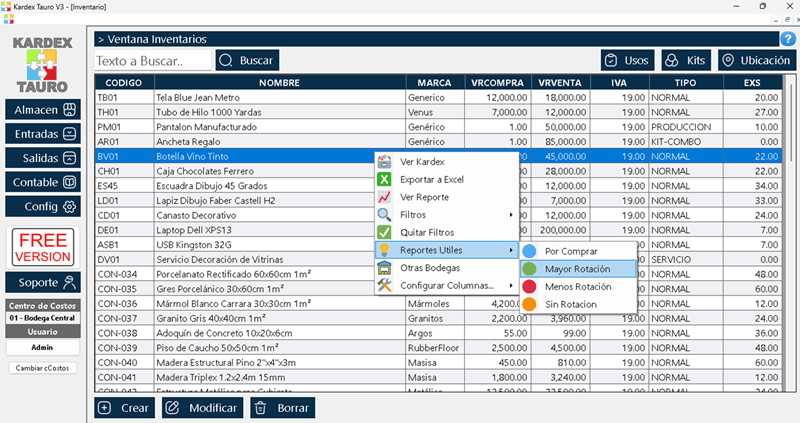
In the end the idea is simple: the policy is written once, applied always and reviewed every year. The best credit is not the one that sells most: it is the one that gets collected. If receivables still live in a spreadsheet, the limit is not the policy but the record; invoicing software that shows limit, due date and aging per customer, such as the one Kardex Tauro offers, turns the written rule into an automatic block.