Debit note template in Excel: free download
Debit note template in Excel: free download
Some charges only appear after the sale has already been invoiced. The customer paid late and interest has to be added, the bank charged a fee on a returned transfer, a freight cost was left out, or extra services were delivered that nobody had priced. The original invoice cannot be rewritten, and pencilling the difference onto a copy is a bad idea: a month later nobody remembers what was added or when.
This debit note template in Excel records those amounts on a single page: number, date, currency, the document it affects, the reason, the charge lines, an automatic subtotal, the tax as an editable cell, the document total and the amount in words.
⬇ Download the template (Excel .xlsx)What a debit note is and who this template is for
A debit note is an office document that raises the value of a sale that has already been invoiced. It does not replace or correct the invoice, it adds to it. That is why it is filed next to the original document, handed to the customer with its own number and kept in the same customer folder. It is the sibling of the credit note: a credit note lowers the value of a sale and a debit note raises it. When a return was settled with a credit note and a new charge shows up later, that charge is settled with a debit note, and both pieces stay in the same file.
It is useful for any business that sells on credit and needs to charge something after the invoice is issued: distributors billing freight, workshops adding parts that were not quoted, service providers billing extra hours, landlords charging late interest, hardware stores adjusting weight or length differences. It also works for the small business that has no system generating these notes and builds them in Excel, because the template already brings the structure and only needs to be filled in.
The field that must never be left blank
The field for the document it affects is the heart of this template. There you write the number of the document whose value is being raised: the invoice, the sale or the equivalent document. Without that piece of data the note floats in the air: a charge appears with no origin, the customer does not recognise what it is for and the later reconciliation turns into a puzzle of calls and emails. A debit note without a document it affects is not a note, it is a loose receipt.
Write it exactly as it appears on the original document, with the same letters and the same digits, so the cross-check is direct. If the affected invoice has several instalments or several items, note the full document and put the detail on the note lines;
A good office habit is to number the notes in a separate series from the invoices and to keep a simple outgoing register with the date, the third party and the document it affects. Then, when the customer asks about a charge, the search is immediate. It also pays to decide in advance who signs and in what order, because a note signed only by the person who prepared it carries less weight than one that went through review.
What the template includes
The whole document fits on one page and every block has a clear job inside the charge:
| Element | What it is for |
|---|---|
| Number and date | Give the note its identity and its order |
| Currency | Make clear what is being charged |
| Document it affects | Tie the note to the sale whose value it raises |
| Reason list | Summarise the type of charge in one word |
| Payment method | Show how the amount is expected to arrive |
| Issuer and third party | Identify who charges and who is charged |
| Twelve detail lines | Describe each charge with quantity and value |
| Line subtotal | Multiplies quantity by unit value |
| General subtotal | Automatic sum of every line |
| Editable tax | You type the amount that applies to the charge |
| Document total | General subtotal plus the tax written |
| Amount in words | Removes any doubt about the final figure |
| Notes and three signatures | Leave a trace of who prepared, reviewed and received |
Sheet columns
The detail sheet has five columns and only one of them calculates itself:
| Column | Type | What you write |
|---|---|---|
| Description | Manual | Concept of the extra charge |
| Quantity | Manual | Units, days or services charged |
| Unit value | Manual | Price of each unit charged |
| Subtotal | Automatic | Quantity times unit value |
| Notes | Manual | Short note about the line |
How the total is calculated: the full example
A typical case shows how the note is built from top to bottom. Debit note number 5 of 30/09 is issued for late interest on invoice F-1045, and the detail looks like this:
| Description | Quantity | Unit value | Subtotal |
|---|---|---|---|
| Late interest for August | 1 | 60,000 | 60,000 |
| Late interest for September | 1 | 45,000 | 45,000 |
| Collection fees | 1 | 15,000 | 15,000 |
The line subtotals add up to 120,000 and that is the general subtotal. No tax is charged in this example, so the tax cell stays at zero and the document total is 120,000, the figure also written out in words. If there were a tax, you would type it into its own cell and the total would move by itself. The figures on the lines are never typed twice: the subtotal is built from quantity times unit value and the total from the general subtotal plus the tax written.
That chain is what makes the sheet useful. If someone corrects a unit value, the line subtotal, the general subtotal and the total all settle at once, and only the amount in words has to be written again. The one figure the template will not guess is the tax, because it depends on the business and on the concept charged;
Notice as well the order of the lines in the example: they run from the oldest to the most recent. That natural order makes it easy to cross-check against the customer statements and makes it obvious that the whole period is being charged and not just part of it. If a month was left out, the gap stands out at once.
How to fill the note step by step
- Write the note number and the date. Keep your own numbering, in sequence and with no gaps, so that no note is ever repeated.
- Mark the currency and note the document it affects: the invoice or sale whose value you are raising.
- Pick the reason from the list, for instance late interest, collection fees, freight or extra services, and mark the payment method.
- Fill issuer and third party with the names and identifiers exactly as they appear on the original invoice.
- Describe each charge on the twelve detail lines, with its quantity and unit value, and let the line subtotal work itself out.
- Check the general subtotal, type the tax if one applies, verify the total, copy the amount in words, add your notes and collect the three signatures.
Tips and common mistakes
- Write the reason in concrete words. A vague label says nothing; a dated reason for late interest says everything.
- Do not mix concepts on one line. Interest and collection fees belong on separate lines so the customer can review each charge.
- Watch the accrual date. Interest runs from the due date, not from the day you remembered the charge.
- Never reuse a number. A duplicate note in the file is the mistake that costs the most time later.
- Do not erase or overwrite the original invoice to bury the adjustment inside it. The debit note lives apart and is filed with the document it affects.
- Keep in mind that signing the note does not turn it into an official document. This template is an internal control and collection tool and does not replace any document an authority may require.
- Note in the remarks the reference of the proof of collection, for instance the number of the collection letter or of the email sent. That detail saves arguments when the customer asks for the basis of the interest.
- Use a single currency per note. If the charge arrives in different currencies, issue one note for each and avoid conversions written by hand.
When to move to software
The Excel template works well while notes are few and somebody files them with care. Once the business issues them every month, once several people are collecting, or once the volume grows, the sheet stops being enough: the history per customer is missing, it is hard to see which notes are still unpaid, and the file fills up with different versions. At that point control is lost, not because of the template but because of the mess.
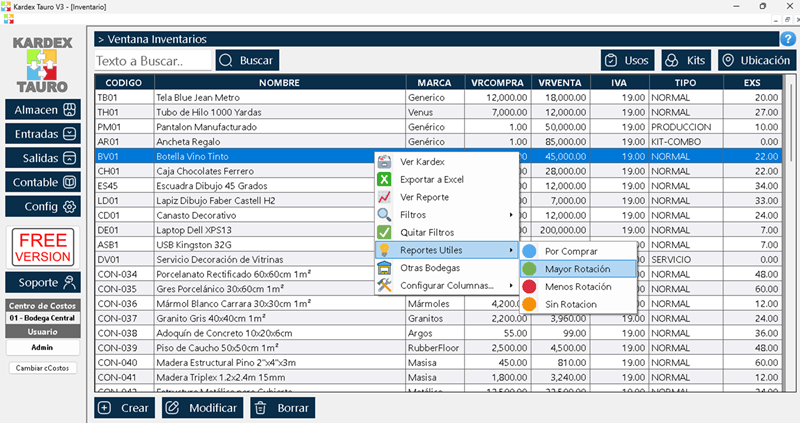
The natural step is to move it into a system that keeps the invoice, the note and the customer balance in one place. Kardex Tauro handles sales, receivables and linked documents, so a debit note is created from the invoice it affects and the balance updates without retyping anything. Even so, it is worth starting with the template: understanding the structure of a debit note is the step before configuring any system properly. Kardex Tauro is not here to replace your judgement, it is here to take away the repetitive work.
Download the template, fill in a test note with the example in this guide and compare the result with your invoice. If the subtotal and the total agree the first time, you already have the control in your hands.
⬇ Download the template (Excel .xlsx)