Notarial letter template for Word
Notarial letter template for Word
Some conversations a business cannot leave hanging: the instalment that has gone months unpaid, the supplier who delivered half the order, the tenant who does not vacate the premises on the agreed date. When a friendly reminder is no longer enough, the next step is a formal communication in writing, dated and with proof that it reached the addressee. This notarial letter template for Word is made for drafting it in good order, without leaving out any of the elements you will need later.
It is used by business owners, managers and accountants in small and medium companies: the distributor claiming on an overdue account, the landlord asking for the return of the premises, the company giving notice to end a service contract. It carries the sections of a letter with a letterhead, from who writes and in what capacity to the record of delivery. You download it, adapt it with the details of the case and print it to sign.
This is a working format, not a document with magic effects. Well drafted and well delivered, it orders the case, fixes a position and leaves proof that notice was given in time. But the weight such a communication can carry depends on the circumstances of each business and on what a lawyer decides about the specific case.
⬇ Download notarial letter (.docx)What it is and what it is for
In everyday practice, the notarial letter is the name given to the formal communication one party sends to another to demand something and to leave a trace that it was sent. It is a document on a letterhead, addressed to a specific person or company, that sets out facts, asks for something and states what follows if there is no reply. What gives it value is not the harshness of the tone but the proof: being able to show what was asked, when and of whom. That proof sometimes comes from the signature of the person who receives it; at other times, from sending it through a notary. Both routes are explained at the end of this text.
- Claiming payment of an overdue obligation, with the amount, the due date and the form of payment you expect.
- Recording a failure to perform: an incomplete delivery, a service that was not provided or goods that arrived in poor condition.
- Demanding the return of property, premises or documents held by another person.
- Giving notice to end a lease or a service contract with the notice period that was agreed.
- Warning about damage or a risk the other party needs to know as soon as possible.
- Setting out a position in writing before the matter turns into a longer dispute.
What the template includes
The file comes with a letterhead and follows the order of a well-built formal communication. These are its actual sections.
| Section | What is written there |
|---|---|
| 1. Who writes and in what capacity | Name or company name, business identification, address and the capacity in which you write: owner, landlord, creditor, supplier or representative. |
| 2. Facts being communicated | The facts in chronological order, each with its date, what happened and the document or evidence supporting it. |
| 3. What is required | What you ask for, by when it is expected and how it should be met: the form of payment, the delivery, the return or the reply. |
| 4. Notice of what will happen without a reply | A sober sentence, in the future tense, stating that the matter will be taken forward through the appropriate channels without a reply within the period. |
| 5. How it is delivered and how the record is kept | Space to note the method of delivery: by hand against signature, by post with acknowledgement, or through a notary. |
| 6. Record of delivery | The person receiving, their identification, the date and time, their relationship to the addressee and the signature. |
| 7. Signature block | Signature and details of the sender, with space for a witness signature when delivery is by hand. |
| 8. Attachments | The list of documents enclosed: invoices, contracts, receipts, photographs, minutes or emails. |
| 9. Control table | Document code, version, date and person responsible, with a two-letter code and a consecutive number for each case. |
Below the signatures sit the control table and the company name in the footer. Those two details are always changed before the file is used: the code for your business's consecutive number and the footer name for your own.
How to build the facts table
The heaviest section is the facts, because it is the only one that can be checked afterwards. It is written as a table, one row per fact, with three columns: when it happened, what happened and what proves it. The order runs from the oldest fact to the most recent.
| Date | What happened | Document or evidence |
|---|---|---|
| The day of the agreement | The parties agreed a delivery, a payment or a service and its conditions | Contract, purchase order or the email where it was confirmed |
| The day the deadline passed | The deadline arrived and the obligation was not met | Delivery notes, receipts or internal delivery records |
| The days that followed | Reminders were sent and there was no reply | Emails, messages or calls noted with their date |
A fact without evidence is an opinion. If the paper or the message backing it does not exist, it is worth asking whether it should be included, because every statement can be called on to be proved. Dates are written in full, without abbreviations that could be read in two ways.
How to use it step by step
- Start with the facts, not with the demand. Write the list of what happened with its dates and check which document backs each one.
- Define the capacity in which you write. Claiming as an owner is not the same as claiming as a landlord, a supplier or a company representative.
- Draft the demand as a single idea: what you want, by when and how.
- Write the notice in a sober tone and in the future, without adjectives or threats you cannot carry out later.
- Replace the company name in the footer and the document code in the control table with your own details.
- Print two copies and read the letter aloud before signing: a misspelled name or a wrong date almost always shows up.
- Deliver the letter and sign the record at that moment, noting who receives it, their identification, the date, the time and their relationship to the addressee.
- Build a folder per case with the copy, the signed record and the attachments.
What to check before signing
- The addressee's full name and address. A letter sent to the wrong person loses strength exactly where it matters most.
- That the facts are in chronological order and that each has its date and its evidence.
- That the demand is clear and single, without open options or deadlines that can be read in several ways.
- That the period is reasonable and can be met: an impossible deadline weakens the sender.
- That there are no adjectives or accusations, and that the company name in the footer and the document code are already changed.
When it is worth moving to a system
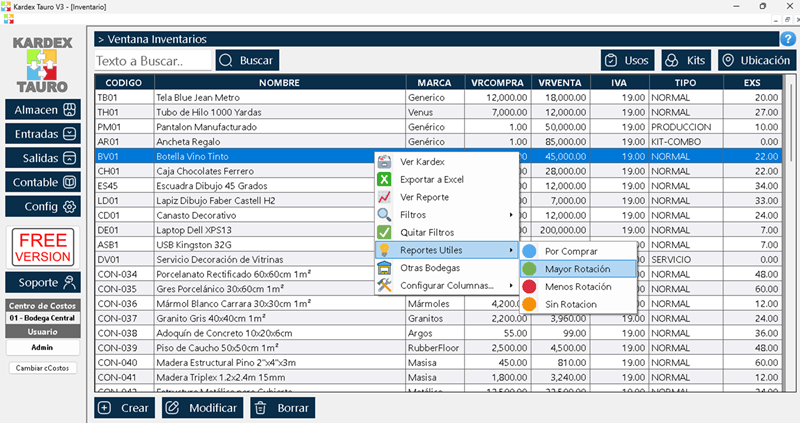
The template handles an isolated case well. The problem appears when cases stop being isolated: a small business handling several overdue accounts and two or three contracts ends up with a physical folder per matter and no quick way of knowing how many cases are open. That is where a system earns its place. It does not draft the letter or decide what to do with the case: it keeps in one place the movements of each customer and supplier, the due dates and the notes from every contact. Kardex Tauro is inventory and operations control software for small and medium businesses that, among other things, keeps information ordered by third party and by movement, which is exactly what you need when the history of an obligation has to be rebuilt. If your business has not reached that point yet, the template is enough to start well.
Internal use, legal advice and the difference from notarial notification
This format is for internal use and does not constitute legal advice. It helps you order the drafting and make sure no detail is missing, but it does not decide whether the claim is well founded, or which route is correct, or which deadlines apply to the specific case. Before sending it to a third party, a lawyer should review the case: the evidence, the capacity in which you write and what you are going to ask for. Every business and every matter has particularities a format cannot foresee.
It also matters to understand the difference between the two ways of delivering a communication like this, because they are not the same and they do not replace each other. The letter with a record of delivery is taken to the addressee and signed on the spot: someone receives it, their identification, the date and the time are noted, and a piece of paper remains proving that the communication reached that person. It is the fastest route and the most common between businesses that know each other.
Notarial notification is something else. It consists of a notary taking part in the sending or the delivery and recording what was communicated, under their own attestation. The practical difference lies in that backing: the record of delivery proves that someone received an envelope; the notary's involvement is designed to give a stronger record when the addressee does not want to receive it, denies having received it, or when it is foreseen that the case will be argued later on. Each notary's office handles its own timings, requirements and costs, and that is discussed with the notary and with the lawyer.
What this format does not do is promise an outcome. It does not guarantee that the letter will have any particular effect, or that the other party will reply, or that it will serve as sufficient evidence in a later dispute. It only ensures that the communication is well drafted and that, if the record is signed, there is a piece of paper showing what was asked, of whom and when. The decision about how to handle the case is a conversation with a lawyer and with the notary, not with the template.
This template is part of the index of Word templates, which gathers them grouped by family.
⬇ Download notarial letter (.docx)