Research project template for Word

Research project template for Word
A research project is decided before it is written. While the topic is still open everything looks possible and nothing feels settled: the readings pile up, the question changes every week, and the work moves forward in your head but not yet on paper. What brings order to that mess is a document of moderate length that fixes, once and for all, what you want to find out, why it is worth doing, how it will be done and how much time you have. That document is a research project, and it is the first thing a supervisor, an academic committee or a funding body reads.
It settles a distinction almost everyone mixes up at the start: the difference between what you want to know and the way you plan to find it out. It is useful for undergraduate students preparing a final paper, for master's students who still doubt whether their topic is workable, for teachers applying for research support, for student research groups, and for professionals who must present a plan before running a study inside their organisation. In every one of those cases the requirement is the same: an orderly proposal with clear criteria, handed in on time. What a committee turns down is often not the topic but the way it is presented: objectives nobody can follow, a method that never says where the data will come from, or a schedule that cannot be met. The template goes after exactly that, because it puts one question after another until the plan stands on its own.
This research project template for Word gathers in a single file the sections that almost every institution asks for, in an order that still works when the local rules give them other names. It includes the cover page, the objectives chart, the schedule by stages and the version control table. It does not come with the content filled in: it comes with the structure, the guiding questions and the spaces where you write. It opens in Word, adapts to the style your faculty requires, and saves as an editable file or as a fixed file to send.
⬇ Download research project (.docx)What it is and what it is for
A research project is the written plan that comes before the research itself: it states what you want to find out, why it matters, how it will be done and with what resources. It is not the final report or the results chapter, but the working commitment that is reviewed and approved before you begin. It is useful, specifically, to:
- Get approval from your supervisor or the academic committee before collecting the first piece of data.
- Apply to an in-house research call at your university or research group.
- Ask for funding, fieldwork support, materials or protected time to carry out the study.
- Narrow a topic that arrived too broad, because it forces you to choose a scope you can actually cover.
- Anticipate permissions, risks and resources while there is still time to sort them out.
- Put the agreement with your supervisor in writing: when you both sign the same document, expectations are clear.
What the template includes
The file has ten sections and a control table at the end. The table below sums up what goes in each part.
| Section | What goes in it |
|---|---|
| Project data | Working title, author or authors, supervisor, programme, line of research and date of submission. |
| Question or hypothesis | The main question in one sentence, the secondary questions and the working hypothesis, where the study allows one. |
| Objectives | One general objective and the specific objectives, written with verbs you can verify. |
| Justification and scope | Why the topic matters, who benefits from the result, what the study includes and what stays outside it. |
| Background | What has already been researched on the topic, the sources consulted and the gap this work intends to fill. |
| Method | Approach, type of study, population and sample, data collection techniques and the plan for analysing the data. |
| Schedule by stages | The stages of the work in order, with the expected length of each one and the products it delivers. |
| Expected results | What you expect to obtain, the form in which it will be presented and how it will be shared. |
| Resources and risks | Human, technical and financial resources, plus the risks you can foresee and how you will reduce their impact. |
| Control and signatures | Version table with the document code, the dates, the changes made and the signatures of author and supervisor. |
The first page is the cover, with space for the logo and the institution name, and the sections follow in the order in which they are read. The objectives chart is there so you can check at a glance whether each specific objective answers one part of the question, and the control table at the end is what keeps the file tidy: version, date, change made and who signs it. The template does not include finished content or a list of possible topics, because the research is yours to supply.
Adaptations by type of study
The structure works for any approach, but some sections are written differently depending on what you are going to do. It is worth adjusting them before you start writing, so the document does not fill up with parts you will delete later.
- In a quantitative study, the question or hypothesis is written as a relation between variables, and the method must name the sample and the measurement techniques.
- In a qualitative study, the question is usually more open, the hypothesis gives way to the categories of analysis, and the method explains how what people say will be interpreted.
- In documentary or review research, the background section grows and the fieldwork section disappears, because the sources are texts that have already been published.
- In an applied or intervention project, it pays to spell out the expected results and the resources, because the final product is judged together with the process.
- If the study involves people, add a part on how the information will be handled and which permissions are needed, from the first version of the document.
How to use it step by step
- Download the file, save it under your own name with your surname, the topic and the version, and fill in the project data section first. If you cannot write the title in one short sentence, the topic is not ready yet and it is worth talking it over with your supervisor.
- Write the main question and, below it, the general objective. If the question cannot be answered with data, rewrite it before going on; everything else depends on that sentence.
- Adjust the specific objectives: one for each aspect of the problem, with verbs you can verify, such as describe, compare, measure or propose.
- Complete the method with the approach, the population and the collection techniques. Do not leave the analysis for the end: write now how you will process the data.
- Build the schedule by stages and give each one a realistic length. The calendar is the most honest filter of the proposal.
- Check the footer and replace the institution name that comes with the format with the name of your university, faculty or research group, together with the city and the year.
- Update the document code in the control table: write the version, the date and the change made, and note who reviews it. Every edit should be recorded in that table.
- Read the whole thing aloud one last time, delete whatever does not hold, and send the file to your supervisor in time for them to read it before the meeting.
Common mistakes
- Writing objectives that cannot be checked, such as understand or reflect, which do not say what will be measured or how you will know it was met.
- Mistaking the justification for a summary of the topic: it should answer who benefits from the result, not repeat what the topic is about.
- Promising a wider scope than your time and resources allow; it is better to cover little and cover it well than to announce too much.
- Leaving the background section as a list of authors, without saying what each one adds and what gap is still open.
- Forgetting permissions, such as the consent of the people taking part or the authorisation to use an institution's data.
- Handing it in without checking the footer and without updating the code in the control table, so the committee receives a document that claims to belong to another institution or to an earlier version.
When it is worth moving to a system
The Word template is enough while the project is a single one, runs through few hands and answers to nobody but the supervisor. It becomes awkward as the group grows: several people edit the same file and nobody knows which version is current, deliverables and dates live in different email threads, and the progress report forces you to rebuild by hand what had already been written. That is the point where a loose document stops being a help and starts being the problem.
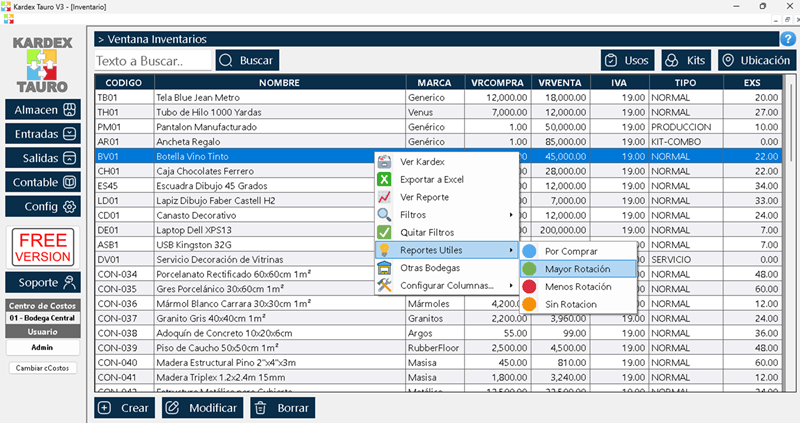
When that moment arrives, it is worth moving to a system that keeps the project, its stages, its owners and its history in one place. Kardex Tauro is one option for that step: it keeps the project with its data and its schedule, records who changed what, and builds the reports from the same information. If your work is a single document delivered once, the template will do; if it repeats every term or several people share it, a system saves time and ends the arguments about which file is the good one. In the meantime, the template remains the best starting point: begin with it, hand it in, and only look at a system once the project grows.
This template is part of the index of Word templates, which gathers them grouped by family.
⬇ Download research project (.docx)