Journal voucher template in Excel: free download

Journal voucher template in Excel: free download
At the end of the day some transactions are hard to trace: a sale paid in cash, a purchase bought on credit, the rent paid out of the cash box. The movement was written in a notebook or on a loose sheet, but there is no signed paper behind it, with its number, its date and the names of the person who prepared it and the person who checked it. Months later, when somebody asks why that account moved, there is nothing to show.
This journal voucher template in Excel is a one-page form per entry: voucher number, date, currency, prepared by and reviewed by, fourteen lines, debit and credit totals, a status box that says whether the entry balances, the amount in words, an observations band and three signatures at the bottom.
⬇ Download the template (Excel .xlsx)What a journal voucher is and who it is for
A journal voucher is the paper behind an accounting entry. It is filled in when the transaction happens, numbered, signed and filed. Each voucher collects the lines that the transaction touches: one account that receives on the debit side and one or more accounts that give on the credit side, or the other way round, always with the same total on both sides.
The template is meant for small and mid-sized businesses that keep their books in Excel or that want the paperwork in order before handing it to their accountant: shops, workshops, restaurants, clinics, service companies, and also bookkeeping offices that receive loose documents from clients and need one uniform sheet to file them.
It also helps anyone who does not have accounting software and wants a written record of every movement, even when the spreadsheet entry is typed later. The voucher is the document; the general journal is the list of those documents.
How it differs from the general journal
It is the difference between the paper and the register. The general journal is ordered by date and runs sequentially: row one comes before row two, and every line of the same entry shares the same number. The voucher, instead, is a single sheet with its own header, filled in once and filed in a folder by number. One voucher can hold a complete entry, and the general journal holds the summary of every voucher in the period.
That is why the running number matters so much: it is the thread that ties the paper to the journal line. If a voucher is cancelled, the sheet is not torn out and the number is not reused; it stays in the folder with a cancellation note, so the sequence can be followed without gaps.
The template carries no tax tables and no withholding calculations: it is an internal control tool and it does not replace any official record. Everything written on it —accounts, third parties, documents, amounts— is decided by the business together with its accountant.
What the template includes
| Section | What it holds | What it is for |
|---|---|---|
| Header | Voucher number, date, currency and document type | Identify the sheet inside the sequence and inside the period |
| Sign-off boxes | Prepared by and reviewed by | Show who filled the sheet in and who checked it before signing |
| Entry body | 14 lines with code, account name, description, third party, document, debit and credit | Write one line for every account the transaction touches |
| Totals | Sum of debit, sum of credit and the difference | See at a glance whether both sides agree |
| Status box | Automatic balanced or out of balance message | Catch the gap before printing and signing |
| Amount in words | A band to write the entry amount in words | Leave the figure without ambiguity, as on a cheque |
| Observations | A two-row band | Note the explanation that does not fit in the description |
| Signatures | Three areas: prepared, reviewed and approved | Close the document with identified responsibility |
The sheet is set up for A4 paper in portrait orientation: one entry per print. The fourteen lines cover most day-to-day transactions; if an entry needs more, it continues on a second voucher with the same number and a continuation note.
The columns on the sheet
| Column | What goes in it |
|---|---|
| Code | The account code from the business chart of accounts |
| Account name | The full name of that account, so the voucher can be read without the catalogue |
| Description | The explanation of the line: what was bought, sold or paid |
| Third party | The customer, supplier or employee involved in the transaction |
| Document | The number of the paper behind the line: invoice, receipt, transfer |
| Debit | The amount that comes into that account |
| Credit | The amount that goes out of that account |
Seven columns and two rows of signatures are all it takes. The template keeps the difference column next to the totals, because an out of balance notice without a figure says nothing; with the difference written down you can tell whether a small amount is missing —a mistyped line— or whether the entry was left half done.
How the check works, with a worked example
The totals in the template are plain sums: the debit total cell adds the debit column of the fourteen lines, and the credit total does the same with its own column. The difference is a subtraction between those two totals. The status box compares both and prints the matching message.
Take a real voucher: number 12, dated 30/09, with four lines, one cash sale of goods and one purchase of goods on credit recorded on the same sheet.
| Line | Account | Description | Debit | Credit |
|---|---|---|---|---|
| 1 | Inventory | Purchase of goods on credit | 800,000 | |
| 2 | Cash | Cash sale of goods | 1,200,000 | |
| 3 | Suppliers | Purchase of goods on credit | 800,000 | |
| 4 | Sales | Cash sale of goods | 1,200,000 | |
| Totals | Total for the voucher | 2,000,000 | 2,000,000 |
Total debit is 2,000,000 and total credit is 2,000,000: the difference is zero and the status box reads balanced. Had someone typed 1,200,000 in the credit of Sales and 120,000 in the debit of Cash, the difference would be 1,080,000 and the message would switch to out of balance, which puts the mistake in front of you before printing. The sheet does not guess where the mistake is: it only reports that one exists and how big it is.
The amount in words is written by hand, exactly as on a cheque, and the status box can be read even from the spine of the folder when the vouchers are filed in order.
Step by step
- Write the running number and the date. The number is never repeated: if a sheet is spoiled, it is kept with the note and the next voucher takes the next number.
- Fill in the currency and the type of document that supports the transaction, so anyone reading the voucher knows what stands behind it.
- Complete one line for every account the entry touches, with code, name, description, third party and document.
- Spread the amounts: debit for the accounts that receive and credit for the accounts that give, until both columns show the same total.
- Check the status box and the difference column. If it says out of balance, fix the lines before going on; never sign a voucher that does not balance.
- Write the amount in words, add the observations and collect the three signatures: prepared by, reviewed by and approved by.
Tips and common mistakes
- One number per entry, not per line. All four lines of voucher 12 carry the number 12; if each line is numbered on its own, the file loses the thread and the journal stops matching the folder.
- Number in order, with no gaps. The running number is what proves that no sheet is missing. Cancelled vouchers stay in the folder with their note.
- Sign last, not first. The signature block exists so that somebody checks the totals calmly; signing on autopilot turns the review into an empty step.
- Never mix two dates on one voucher. An entry belongs to one period; when a transaction crosses the month end, it is recorded on the date the movement belongs to.
- Keep the description useful. A note such as various or adjustment explains nothing six months later; write what was bought, from whom and with which document.
- Remember what this template is. It is an internal control tool: signing it does not turn it into an official document and it does not replace any record the authorities may require.
When to move to accounting software
While the business has a few transactions a day, printing one voucher per entry and filing it by number works well: it is quick to check, easy to sign and easy to find. Trouble starts when the volume grows: hundreds of vouchers a month, several bank accounts, credit sales that must be followed one by one, and month ends that drag on because everything has to be added up by hand.
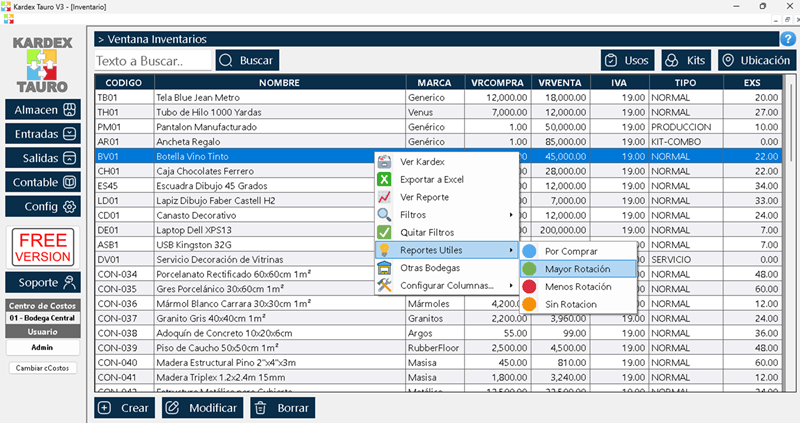
That is the point to move to a tool that numbers, balances and files on its own. Programs such as Kardex Tauro do that work: they post the entry, warn when it does not balance and keep the voucher stored so it can be looked up or printed when needed. The Excel template stays useful even then: it is used to print the voucher of the day, to train whoever joins the team and to rebuild the paperwork of old month ends that were never digitised.
If the business is only now putting its books in order, this is a good place to start: download the template, fill it in with the day's transactions and keep the vouchers in order. The habit of numbering and signing every entry is worth more than any program, and when the software arrives the file will already be ready to migrate.
⬇ Download the template (Excel .xlsx)