Business model canvas template for Word
Business model canvas template for Word
A business model canvas is a single sheet that sums up how a company creates value and how that value turns into money. Instead of writing twenty pages, the canvas spreads the information across nine blocks that can be read at a glance: who you work with, what you must be very good at, what you offer the customer, how you reach them, how you look after them, what it costs to keep the operation running and where the money comes in. That single view is exactly what the owner of a corner shop, a warehouse, a store or a small business needs when they want to put their business in order without hiring an outside consultant.
This business model canvas template for Word comes with the board already laid out. It is not a blank sheet with a heading: it includes the nine-block grid ready to fill in, the tables for customer segments, revenue streams, cost structure and hypotheses to validate, a section for risks and assumptions, and the signature block with the document control table. You open it in Word, complete it with the team in the room, and it becomes the reference document for the business for the whole year.
It is used by the owner, the manager, the purchasing lead and the counter salesperson; it also helps when two partners need to write down what each of them understands the business to be before putting money in. Its greatest value is that it forces the awkward questions early: who you really sell to, how much you charge and how often, and which expense jumps the moment sales start to grow.
⬇ Download business model canvas (.docx)What it is and what it is for
The canvas does not replace the long business plan: it comes first and puts it in order. It is the tool for thinking through the whole business at one table, with the team in front of you, and for writing down what usually lives only in the owner's head. In practice it is used to:
- Explain the whole business in five minutes to a partner, a supplier or someone about to lend money, without opening folders or hunting for paperwork.
- Spot the weak block at a glance: if the revenue streams are unclear, or if fixed costs eat the margin, the board shows it immediately.
- Compare scenarios before deciding, such as opening a second location, adding home delivery, selling wholesale or starting to sell through social media.
- Get partners and the family that owns the business to agree on what comes first and what can wait, with the same sheet on the table.
- Organise the conversation with the accountant, the adviser or the bank, because every block forces you to have its figures at hand.
- Review the business every six months and note what changed in prices, customers, channels or costs, so last year's decisions are not simply repeated out of habit.
What the template includes
The file follows an order that moves from the general to the specific. Every section is filled in with short phrases and real figures from the business, not with filler text. These are the actual sections of the document:
| Section | What goes there |
|---|---|
| General details | Business name, the person responsible for the canvas, the date it was prepared and the period the analysis covers. |
| Canvas board | The nine-block grid: key partners, key activities, value proposition, customer relationships, customer segments, key resources, channels, revenue streams and cost structure. |
| Value proposition | What problem the business solves, for whom, and why the customer picks you rather than the competitor around the corner. |
| Customer segments | A table with the segment, who they are, what they need, where they can be found and how much of a priority they are. |
| Revenue streams | A table with each source, how you charge, its estimated share of sales and how often the money comes in. |
| Cost structure | A table with the type of cost, what it covers, whether it is fixed or variable and the currency it is kept in. |
| Hypotheses to validate | A table with each hypothesis, how it will be tested in practice and the result obtained. |
| Risks and assumptions | What can go wrong, what is being taken for granted without proof, and what will be done in each case. |
| Signatures and control | Prepared by and approved by, plus the control table with the document code and its version history. |
The nine blocks on the board
The board reads from left to right like a chain: first what you need to have, then what you offer, and finally what comes in and what goes out. It is best filled in that order so you do not jump between subjects. Here is an example of what goes in each box for a neighbourhood business:
- Key partners: wholesale suppliers, the carrier who brings the goods, the workshop that repairs the refrigeration equipment and the neighbouring premises that lends parking space.
- Key activities: buying well, receiving and checking goods, storing by category, serving the counter, dispatching orders and keeping the warehouse reconciled.
- Value proposition: fair prices with stock always available, service that solves problems and same-day delivery across the area.
- Customer relationships: direct, trusted dealings, orders by message, alerts when new stock arrives and fast handling of complaints.
- Customer segments: households in the neighbourhood, small shops buying wholesale, restaurants, hardware stores and nearby offices.
- Key resources: the premises, the inventory, the freezer, the delivery van, the billing system and the knowledge of suppliers.
- Channels: the shop and its window, the telephone, the courier and the business page with its catalogue.
- Revenue streams: retail sales, wholesale sales, delivery with a surcharge and made-to-order purchases.
- Cost structure: rent, utilities, payroll, purchase of goods, transport and upkeep of the equipment and the vehicle.
How to use it step by step
- Download the file and open it in Word. Straight away, save a copy with the business name and the date in the file name, so you can work without overwriting the original.
- Complete the general details: business name, the person responsible for the canvas, the date and the period the analysis covers.
- Fill in the nine-block board out loud with the team, one block at a time, using short phrases. If a block stays empty, that is the first item for the next meeting.
- Develop the value proposition in one simple paragraph: what problem it solves, for whom and why the customer picks you.
- Move the customer segments into the document table with a clear priority: who is served first when time or stock is short.
- Build the revenue streams and the cost structure with figures from the last closed month, comparing fixed with variable to see what happens if sales fall.
- Write the hypotheses to validate and the risks and assumptions section, with a concrete way to test each one: ask customers, try a price, measure one channel for a month.
- Check the footer and replace it with your company name and details, and in the control table replace the document code (it appears as [BC-___]) with the number your own filing uses, so every version can be traced. Then sign it off with the person who prepared it and the person who approved it, and save the final version in the business documents folder.
Common mistakes and what to check before signing
Before calling the canvas finished, go through these points. They are the ones that come up most often, and the ones that make the document useless:
- Blocks filled with long, decorated sentences: the canvas works with short phrases; if a block needs a whole paragraph, it does not belong there.
- Confusing what you want with what happens today. The canvas describes the real business, not the ideal business of the next decade.
- Leaving the small costs that repeat every week out of the cost structure. That is usually where the difference between making money and not making it lives.
- Confusing money coming in with profit: high turnover does not mean much is left over, and the board is there to show exactly that.
- Leaving hypotheses with no way to test them and no date. A hypothesis with no test is just an opinion in good handwriting.
- Signing without checking the footer and the control table. A document with another business name in the footer loses credibility with a bank or a partner.
When it is worth moving to a system
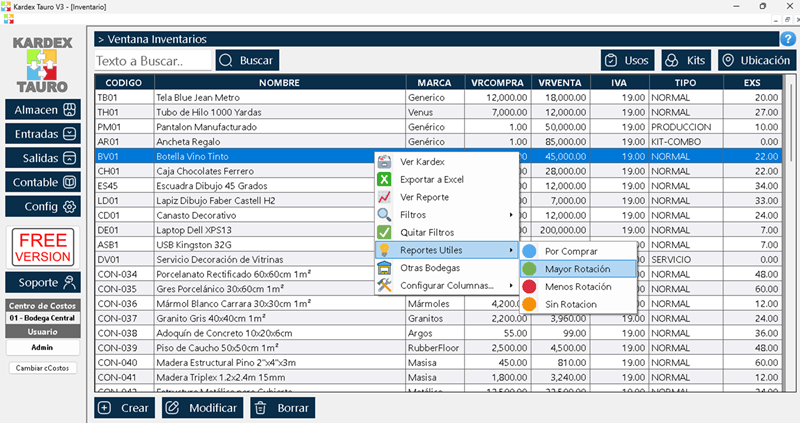
The Word canvas is excellent for thinking, ordering and arguing, and for that nothing beats it once every six months. But a point arrives when the business needs its figures to update themselves. When there are several shops or locations, when stock moves every single day, when purchases and sales no longer fit in the owner's memory and when decisions are taken from reports rather than recollections, it is time to move to a system. That is where Kardex Tauro comes in: the canvas sheet stays as the strategy document and the system takes care of the day to day, with sales, stock and costs kept up to date, so the next canvas review is done with data instead of estimates.
This template is part of the index of Word templates, which gathers them grouped by family.
⬇ Download business model canvas (.docx)