Customer satisfaction survey template for Word

Customer satisfaction survey template for Word
In any business that serves the public, customer opinion arrives all the time, but out of order: a remark while paying, a message to the owner's phone, a complaint said out loud, a polite "all good" that means nothing. That feedback is valuable, yet it rarely tells you what you need to know: what was done well, what should be fixed first, and whether a problem is a one-off or keeps coming back.
A satisfaction survey does the opposite. It makes the same questions get asked the same way, to different customers, every month. Once that holds, the averages start to speak: which points hold up, which dropped since last month, and where in the service you are losing people. That is the moment opinion stops being an anecdote and becomes a decision.
This customer satisfaction survey template for Word is a two-page internal form. The customer fills in the first page at the counter, in under three minutes. The team uses the second page to tabulate the results and write down the action plan. It was designed for small shops, warehouses, stores and small businesses that serve the public and want to organise their service without setting up a complicated platform.
⬇ Download customer satisfaction survey (.docx)
What it is and what it is for
The survey works when it is applied with discipline. Used once, it is a snapshot; applied regularly, it is a series that shows where the service is heading. These are its concrete uses:
- Measure service with a single criterion, so one customer's opinion can be compared with the rest without depending on who asked.
- Compare periods: this month's average against last month's, question by question, not just a general "everything is fine".
- Spot a specific problem early, such as a waiting time that grew or a delivery that keeps slipping, before it becomes customers who never come back.
- Recognise what the team does well: the highest-scoring questions are information too, and they show what to keep.
- Set priorities: with the averages in hand, you decide what to fix first and what can wait for the next period.
- Keep verifiable records for complaint follow-up and for the decisions taken about service.
What the template includes
The file has two pages, ten content blocks and a control table. This is the walk-through, in the order it appears:
| Section | What goes there |
|---|---|
| 1. Survey details | Business name, branch or location, date, period being measured, name of the person applying the survey and how many forms were handed out. |
| 2. Introduction for the customer | A short two- or three-line text explaining why the survey is being done, how long it takes and whether the answers are anonymous. |
| 3. Instructions | How to mark the one-to-five scale, what "not applicable" means and where to write a comment. |
| 4. Customer details (optional) | Name, ID, contact, whether the customer is new or regular, and the date of the last purchase. If the customer prefers not to leave them, the survey is still tabulated. |
| 5. Rating questions | Ten ready-written questions, each with its one-to-five columns, a "not applicable" box and a narrow comment column. |
| 6. Open questions | Three ready-written questions so the customer can say in their own words what they liked, what bothered them and what they would change. |
| 7. Recommendation and closing comment | Whether the customer would recommend the business to someone they trust, plus free space for a closing remark. |
| 8. Data consent | The paragraph explaining what personal data is used for and the space for a signature, only if the customer chooses to leave their details. |
| 9. Page 2: tabulation and action plan | Table with question, average, what the answers show, action, owner and date. |
| 10. Internal closing | What was decided, who reviewed the survey, how many responses were tabulated and when the next measurement takes place. |
| Control table | Code [EC-___], form version, date of issue and page number. |
| Signatures | The person who applied the survey, the person who reviews the results and the person who approves the action plan. |
The ten rating questions
The questions come ready-written in the file, and rewriting them every month is a bad idea, because then the averages stop being comparable. Each one is answered on a one-to-five scale and allows the "not applicable" box when the topic did not come up in that purchase. This is what each question measures:
| Question | What it measures |
|---|---|
| Service received | How staff treated the customer: whether they were friendly, willing to help and made the customer feel welcome. |
| Price clarity | Whether the price was stated before payment, was visible and was understood. |
| Waiting time | How long the customer waited to be served and to receive the product or service. |
| Choice available | Whether the customer found what they were looking for and whether the range seemed enough. |
| Condition or quality | Whether the product arrived in good condition, complete and at the expected quality. |
| Delivery as promised | Whether what was promised was delivered on the agreed date and in the agreed form. |
| Ease of exchange or return | Whether exchanging or returning an item was straightforward, without long procedures or arguments. |
| Response to a problem | Whether the business responded when something went wrong and whether the solution arrived in time. |
| Information received | Whether the customer understood what was explained: how to use the product, the terms of the purchase, the warranty or the next steps. |
| Overall impression | The general sense of the business: order, presentation and trust. |
How to use it, step by step
- Download the file and save it with the name of the branch and the period being measured, so it does not get mixed up with other months.
- Replace the company name and contact details in the footer with your organisation's; if the form is already personalised, check that the information is still current.
- Write in the control table the [EC-___] document code for this survey, the form version and the date it is filled in.
- Decide the period and the sample: how many days it will run, how many forms are handed out per branch and whether every customer or only a share receives one.
- Print the first page and hand it over at the end of the purchase, with a pen. Explain the scale in two sentences: one means very dissatisfied and five means very satisfied, and there is a "not applicable" box for anything that did not come up.
- Move the results to the second page: average per question, which one improved since the last period and which one got worse.
- Write the action plan with concrete actions, an owner and a deadline; without an owner and a date, the table stays a list of good intentions.
- File the completed surveys with the period's tabulation and tell the team what came out and what is going to change.
Common mistakes
- Handing it only to customers who look happy. The survey is useful when it shows the month as it was, good and bad.
- Filling the form in for the customer, or standing next to them giving hints while they answer. That taints the response.
- Changing the questions every month. If they change, the averages are no longer comparable with the previous period.
- Applying it at the worst moment: when the customer is in a hurry, when there is a queue, or at the end of a busy day.
- Tabulating everything into one overall average. A single number hides the fact that waiting time fell while service rose.
- Tabulating and deciding nothing. A survey with no action plan stops interesting the team within two months, and the customer within one.
- Reading a single complaint as a trend. With few responses, one case carries too much weight; look at the whole set.
When it is worth moving to a system
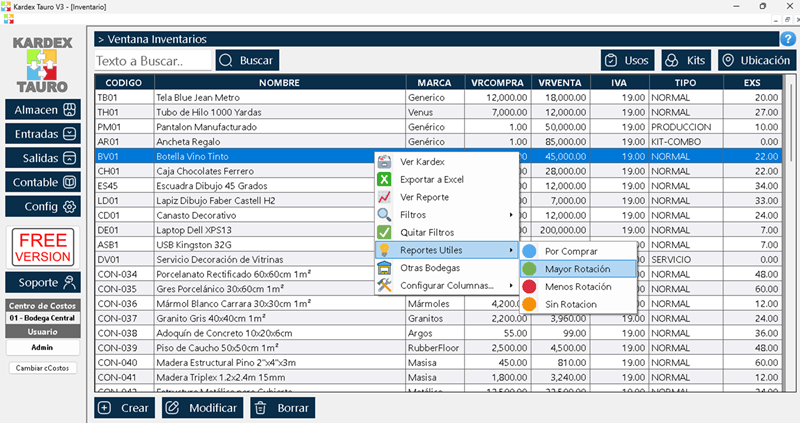
The Word template is enough as long as the operation fits in two pages and an averages table. It stops being enough when the surveys no longer fit in a folder, when the business has several branches and nobody consolidates the results, or when the action plan gets written, signed and then lost because nobody looks at it again. At that point, keeping up with the follow-up by hand costs more than doing it with a tool. Software such as Kardex Tauro helps keep the operation organised when customer service overlaps with stock movement, orders and inventory; it is worth checking whether it fits the way your business works before taking that step.
The advice is simple: do not swap the template for a system just because it is fashionable. Swap when you can no longer answer, in under a minute, which point was scored worst last month and who was left in charge of fixing it. Before that, the Word form is still the most reasonable option, and it works just as well in a corner shop as in a warehouse with two storage rooms and several salespeople.
This template is part of the index of Word templates, which gathers them grouped by family.
⬇ Download customer satisfaction survey (.docx)