Written warning letter template for Word
Written warning letter template for Word
A written warning letter is the internal document a company uses to record, in writing, an instance of non-compliance and the measure it decides to apply. It is not an improvised punishment or a way for a manager to let off steam: it is an orderly record that tells the employee exactly what is being pointed out, gives them room to present their side, and lets the company show later that it acted on criteria and in a consistent way.
In small warehouses, stockrooms, shops and workshops the problem is rarely a lack of authority; it is a lack of records. The manager talks with the employee, both agree to do better, and three months later nobody remembers what was said or when. If the same thing happens again, the company has nothing to support the conversation, and the employee does not remember what was asked either. This template fills that gap: it turns an awkward conversation into a short, orderly and respectful document that both sides can read, discuss and sign.
It is designed to run one to two pages, with the company letterhead, a communication number, a document code and a control table. It works just as well for a spare-parts warehouse, a neighbourhood shop, a food distributor or a service workshop, and it fits a written verbal warning, a formal warning or a suspension, depending on what the company decides to apply under its own internal rules.
⬇ Download written warning letter (.docx)
What it is and what it is for
In practice the letter does three things at once: it informs, it organises and it protects. It informs because it puts in writing which instance is being pointed out, with a date and detail; it organises because it forces the company to decide a specific measure and to set commitments that can be verified later; and it protects because it creates a record that serves both sides: the employee, so their version is kept, and the company, so it can show the case was handled methodically rather than on impulse.
It is best used once the event has already happened and has already been discussed, not as a first notice out of the blue. The letter does not replace the conversation: it closes it and documents it. That is why the format works for concrete, verifiable events, and not for collecting loose annoyances or trying to correct every problem of one person at once.
- Recording a specific event with its date, place and consequence, instead of a general complaint about someone's attitude.
- Giving the employee a document they can read calmly and answer, rather than a single remark delivered in the aisle.
- Logging the employee's version and any evidence or witnesses they bring, so the case file is complete and balanced.
- Setting improvement commitments with a deadline, an owner and a way to verify them, so the conversation ends in something concrete.
- Keeping an orderly history for each employee, useful when reviewing performance, renewing a contract or deciding a promotion.
- Standardising how the company communicates these cases, so two managers do not act in two different ways on the same facts.
Tone is part of the content. A letter that describes facts, with dates and supporting documents, and that leaves room for the employee's version, stands on its own; a letter full of labels about the person becomes a new problem instead. That is why this template is built on neutral sentences: what happened, when, with what support, and what is expected from here on.
What the template includes
The file is a letter with a letterhead and a control table at the end. These are its actual sections and what is written in each one:
| Section of the format | What is written there |
|---|---|
| Letterhead and communication number | Company name, address, city, phone and email; communication number and issue date. |
| Addressee and subject | Employee's name, ID, role and area; a subject line that sums up the event in a few words. |
| Background of the employment relationship | Start date, role and immediate manager. |
| Events being reported | Table with the date of the event, what happened and the supporting document or witness. |
| Related internal rules | The internal rule, instruction or procedure that was not followed, written exactly as it appears in the company handbook. |
| Employee's version | Date the employee was heard and a summary of what they answered, in their own words where possible. |
| Decision and measure applied | The measure chosen, its scope and how long the record stays active. |
| Improvement commitment | Table with the commitment, the deadline, the owner and how it will be verified. |
| Consequences of a repeat | What the company will do if the event happens again, under its own internal rules. |
| Acknowledgement of receipt and signatures | Text the employee signs to confirm they received a copy, plus the signature block of the person issuing the letter, the employee's signature and the witness's. |
| Copies and document control | Copy to HR, immediate manager and personnel file; code, version, date and document owner. |
Besides the body of the letter, the format carries the signature block of the person issuing the communication, the space for the employee's signature, the space for the witness and the copy line. That set is what lets the document be filed like any other company record, with its code and its version, instead of staying loose in a folder.
The facts table, row by row
The facts table is the heart of the document, because it is the one part that leaves no room for generalities. It is filled with one row per event, in chronological order, and each row answers three questions: when it happened, what happened and what can back it up. If any of the three is empty, that row is not ready to be signed yet.
| Date of the event | What happened | Supporting document or witness |
|---|---|---|
| DD/MM/YYYY | Description of the event: what happened, where, who took part and what consequence it had. One event per row, with no labels about the person. | Document, system record, email, photograph or the name of the person who witnessed it. |
| DD/MM/YYYY | Second event, if there is one. Open a new row even if it happened on the same day, so each point can be answered separately. | Support for the second event, or a note that a witness is available. |
| DD/MM/YYYY | An earlier event already discussed with the employee, when it is part of the case history. | Note of the conversation, email sent, or the witness's name. |
Two details of form that are often forgotten: writing the place where the event happened inside the description, and noting the witness's name together with their role. Without the place, the account is incomplete; without the witness's role, the company cannot locate that person later if it needs to ask again.
How to use it, step by step
- Replace the details in the letterhead and the footer. The file carries a generic company name along with the address, phone and email; if they are forgotten, the document goes out with details that are not yours. Check the last line of the footer as well before printing.
- Adjust the document control table. It holds the code with the communication sequence number, the version of the format, the date and the document owner; the sequence number is what lets you find this case later among the others.
- Fill in the issue date, the city and the communication number, and check that they match the day the letter is handed over.
- Complete the background of the employment relationship: start date, role and immediate manager. These three details place the event inside the working relationship.
- Write the subject in a single line, with the event in a few words. The subject is not a summary of the document: it is the label that lets you file it and find it later.
- Draft the facts table with one row per event and its support, in chronological order. Before moving on, check that no row claims more than the support can show.
- Write the internal rule that was not followed exactly as it appears in the company handbook, and then the employee's version: the date they were heard and a summary of what they answered, in their own words where possible.
- Define the measure, its scope and how long the record stays active, complete the commitments table with a deadline and a way to verify it, and sign. The employee signs the acknowledgement of receipt; if they prefer not to sign, that fact is noted and the witness signs.
After signing, give one copy to the employee, send another to HR and keep the original with its attachments in the area's folder. That file is what will tell the story of the case with dates later on, not the memory of whoever handled it.
Common mistakes to check before signing
- Writing conclusions instead of facts. Comments about someone's character cannot be checked; a description such as did not log the goods leaving on a given day can be reviewed and answered.
- Cramming several different events into one row. Each event needs its own date and support; mixed together, the employee cannot answer point by point.
- Signing before listening. The employee's version section is filled before the signature, not after; left empty, the document tells only part of the story.
- Copying the same letter for several employees. The text loses value when it reads as generic, because the dates, the events and the support differ in every case.
- Forgetting the support or the witness's name. Without backing, the row is one company's statement against the employee's word.
- Treating the notice as a punishment already decided without listening. The letter communicates a decision taken with complete information, not the announcement of something the company has not assessed yet.
When moving to a system makes sense
This template handles the isolated case well. Once a company starts piling up letters, leave requests, minutes and warnings, the limit is no longer the format but the filing: who holds the folder, on which computer the file ended up, which version was the last one signed and on what exact date the copy was handed to the employee. That is where a system helps more than a shared folder.
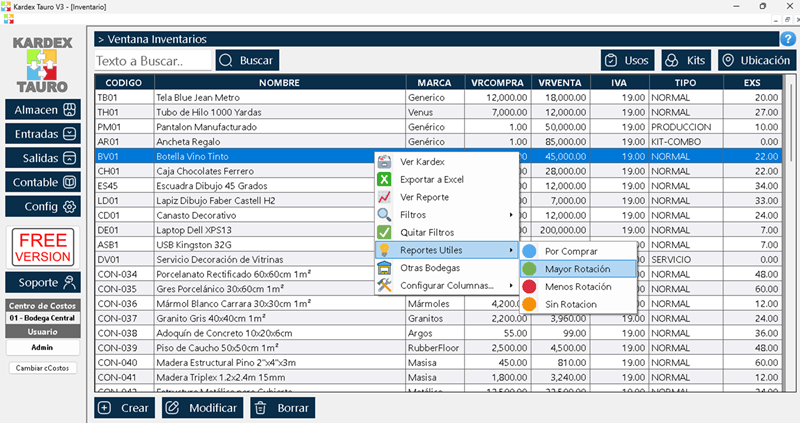
With Kardex Tauro that history stays linked to the employee and the date, and every document can be looked up without opening folders or digging through email. The decision, however, is not technical but one of volume: while the cases are few and well organised, the Word template is enough; when there are many and they need to be looked up quickly, it pays to take the step. Kardex Tauro also keeps inventory and movements in the same place where staff history is stored, which avoids keeping two separate files about the same person.
Internal use, and an important notice
Before using this template, it is worth saying clearly: it is a format for internal use, meant to document a conversation the company has already had with an employee, and it is not legal advice. The text in the file does not decide for you and does not replace a professional's review; it only organises the information so the decision is on record.
Every company has its own internal rules and its own procedure for these cases. That is why the recommendation is to review the format with the company's labour adviser before applying it, and to adjust the measure, the scope of the record and the consequences of a repeat to what that company has set out in writing in its handbook.
One point should not depend on the format: the employee's right to be heard before the measure is decided. The employee's version section exists precisely for that. Listen first, summarise what was said with respect, and only then decide: that order is what makes the document credible for both sides, and also what keeps a company from deciding on incomplete information.
This template is part of the index of Word templates, which gathers them grouped by family.
⬇ Download written warning letter (.docx)