Grading rubric template for Word

Grading rubric template for Word
Marking a piece of work is not the same as assessing it. When the criteria live only in the teacher's head, two students with similar performance can end up with different marks, and neither of them understands where the grade actually came from. A rubric settles that conversation: it forces you to write down, before reading the first submission, what is expected, how much each aspect is worth and what every level of achievement looks like.
This grading rubric template for Word is meant for teachers in primary, secondary and higher education who need to mark consistently and explain their marks. It works for a project, an oral presentation, a lab report, group work, a written piece or a workshop practice. Open it in Word or LibreOffice, adapt it to your subject and it is ready to print or to share with students.
The file carries the full structure of an analytic rubric: assignment details, criteria with four performance levels, a score summary, room for feedback and a control block with signatures. Nothing is tied to one subject, so the same template works in language, mathematics, science, art or technical training.
It is used a lot in secondary and higher education, but it also works in primary school with simpler criteria and in technical training with workshop performance criteria. If you have never worked with rubrics, start with one assessment: pick the task that causes the most arguments when you mark it and build the first table there.
⬇ Download grading rubric (.docx)What it is and what it is for
A rubric is a two-way table: the rows hold the criteria you are going to look at and the columns hold the levels of performance. Crossing the two gives you a concrete description of what a piece of work does at each level, and that description is what lets you mark without inventing the criteria again every time.
It has three uses that reinforce each other. Before the task it communicates expectations and doubles as a working guide. While marking it brings order and speed. After the submission it sustains the conversation with the student about what to improve and how.
The four levels in the template cover the whole real range of a class. The initial level describes work that is barely starting and needs constant support. The developing level recognises partial progress with clear gaps. The satisfactory level is what was expected, with nothing extra. The outstanding level describes work that goes beyond the brief and justifies it. With four rungs the student can see that there is a way up, not just a pass or a fail.
- It is transparent: the student knows in advance what will be assessed and in what words the work will be described.
- It reduces subjectivity: two teachers using the same rubric reach similar results on the same piece, because both are reading the same description.
- It speeds up marking: instead of writing comments from scratch for every student, you tick the matching level and add one short remark.
- It sustains feedback: the description of each level becomes a concrete explanation of what is missing to move up.
- It can assess process, not only product: participation, teamwork, use of sources, presentation or meeting deadlines.
- It leaves a record: if someone later asks why that mark, the answer is already written and signed.
- It can be handed out before the task, so the rubric also works as a self-assessment checklist for the student.
- It makes peer review easier: with the same table, two classmates comment on each other's work against a shared standard.
What the template includes
The document is split into seven sections that follow the normal course of an assessment, from identifying the assignment to recording who marked it and who received the result.
| Section | What you write |
|---|---|
| 1. Assignment details | Institution, subject, teacher, name of the work, class or group, submission date and the total score for the assessment. |
| 2. How to use it | Short instructions for the student and for the marker: what the levels mean, what each criterion is worth and how feedback is delivered. |
| 3. Criteria and levels | The main table: one criterion per row and four levels (initial, developing, satisfactory, outstanding) with a description of what is seen at each one. |
| 4. Score summary | Subtotal per criterion, score obtained, score possible and its equivalence on the scale the institution uses. |
| 5. Feedback | Room to write what went well, what must be corrected and one concrete step for the next submission. |
| 6. Remarks | Context notes: difficulties in the group, adaptations applied, agreements reached with the student. |
| 7. Control and signatures | Document code, version, review dates, teacher signature and confirmation by whoever receives the assessment. |
On scoring, it pays to decide early whether every criterion is worth the same or whether the weight changes with the importance of the performance. In an oral presentation, for instance, the clarity of the argument may be worth more than punctuality. What matters is not the number you choose but that the split is written into the template and identical for every student in the group.
How to use it step by step
The template is ready to be written over. These steps get it working in under an hour and stop you from rebuilding it in the middle of the term.
- Replace the institution name in the footer and, if you need it, add your school logo in the header.
- Update the document code in the control table: tag it with the subject and the school year so you can tell it apart from older versions still in circulation.
- Write the criteria around what the student must demonstrate, not around what the teacher must mark. Four to six criteria are usually enough.
- Define the four levels with observable verbs and avoid vague adjectives: better «uses two sources and cites them in the text» than «uses sources».
- Divide the score across the criteria according to their real importance and write each value in its row.
- Test the rubric on a piece from the previous term or on your own example. If you hesitate between two levels, the description is still ambiguous.
- Hand the rubric to the class before the task, not after marking: that is when it can still guide the work.
- When marking, tick the level reached, add up the score and write the feedback while the work is in front of you, rather than leaving it for later.
If you are going to reuse the rubric across several classes, save one copy per group before you start marking. That way the original file stays clean and each class keeps its own record of scores and remarks, with no notes from one group mixed into another.
Common mistakes
Most rubric problems do not show up while marking; they show up while designing. These are the ones that come back most often in the classroom.
- Criteria that describe content instead of performance: a row saying which topic was asked does not say how the answer was assessed.
- Levels that only swap adjectives. If the top level is not separated from the next one by a concrete action, the rubric discriminates nothing.
- Too many criteria: an endless list stops being useful during marking and the teacher ends up scoring from memory.
- Not stating what each criterion is worth, so nobody can tell where the final score comes from.
- Using the rubric only as a score sheet and leaving the feedback space blank, which is where half the value sits.
- Reusing it without reviewing it: this year's version has to reflect what is actually being assessed now.
One last check before you use it: read the top-level column and ask yourself whether it describes a real piece of work a student in this class could hand in. If the outstanding level demands something nobody can reach, the rubric becomes decoration and the class stops taking it seriously.
When it is worth moving to a system
The Word template handles the design and the marking of a single assessment well, and for one or two classes it is usually enough. The problem appears when the volume grows: several subjects, assessments that come back every term and marks that have to be consolidated at the end. At that point, keeping every student's score in separate files becomes fragile: versions get lost and nobody knows for sure which score is current.
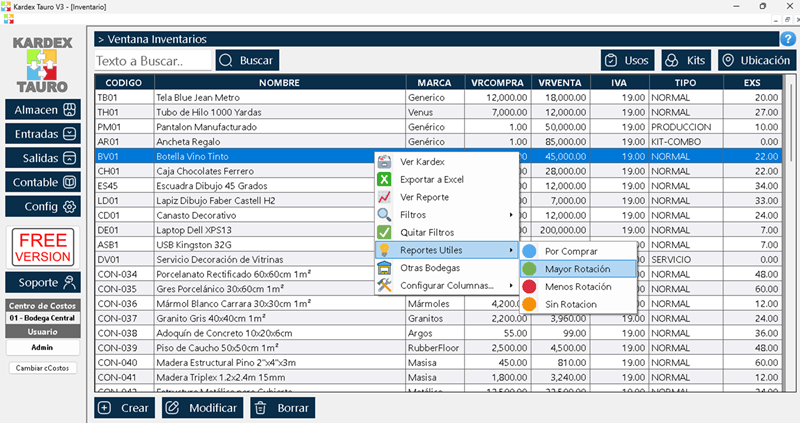
That is when it is worth moving to a system that keeps the history and works out the totals for you. Kardex Tauro is one option for that step, especially if you also need to keep the administrative information around the assessment in order. As long as your work still fits this template, printing it and signing it is faster and you lose nothing.
The practical signal is simple: if closing the term takes you more than one afternoon to work out the averages for a class and you still doubt the arithmetic, you are already paying the cost of doing it by hand. With a single class, the template always wins.
This template is part of the index of Word templates, which gathers them grouped by family.
⬇ Download grading rubric (.docx)