General journal template in Excel: entries that balance

General journal template in Excel: entries that balance
When a sale is paid in cash while goods are still to be received, the business lives two separate events on the same day. If writing them down is left for later, the detail is lost and the month-end close becomes a reconstruction from memory. The general journal exists so that each event is written once, in date order and with the accounts it touches.
This Excel file brings a sheet with two hundred entry lines, a totals row, a balancing block that reports how many entries were recorded and an automatic column that warns, line by line, when the entry that line belongs to does not balance. There are no macros and no add-ins: open it, save it under the business name and start filling it in.
⬇ Download the template (Excel .xlsx)What the general journal is and who it is for
The general journal is the chronological record of the operation. It is the doorway to everything that is later sorted by account in the general ledger and summarised in the trial balance. Each line carries the date, the code and the name of the account, a short description, the document that supports it and an amount written in either the debit or the credit column.
An entry is not a line: it is the set of two or more lines that share the same entry number. The rule that holds the whole exercise together is double entry: within each entry the total of the debit column must equal the total of the credit column. It is not an office formality; it is what guarantees that the record has neither invented nor lost money. If debit and credit do not agree, a line is miswritten or a line is missing.
This template works in shops, workshops, restaurants, hardware stores, bakeries and professional offices, and in any business that wants to keep its day-to-day record without depending on a system yet. It works the same with twenty lines a month as with two hundred: the filling time changes, not the structure.
Why the entry number is the key column
The entry number column looks like a minor detail and it is the one that makes everything else readable. Because the balancing column compares the debit and credit totals of every line carrying the same number, a well-numbered entry checks itself. If two different entries share a number by mistake, the warning fires even though each one is written correctly; if a line is left without a number, it enters no comparison at all and its imbalance goes unnoticed. Numbering consecutively and without repeats is, in practice, half the job.
What the file includes
Everything comes in a single sheet, with the layout already built and the automatic columns ready to work.
| Item | What it brings |
|---|---|
| Entry register | Two hundred lines, one for each account the entry touches. A two-account entry takes two lines; a four-account entry, four. |
| Period totals | Total debit and total credit of every line, on the totals row. |
| Balancing column | Automatic. It walks the block of lines and warns, on each line, whether the entry it belongs to is balanced or out of balance. |
| Balancing block | Below the totals: total debit, total credit, the comparison between the two and the number of entries recorded. |
| Period header | Business name, period and currency, so the file can be identified without opening it. |
| Instructions sheet | A separate sheet explaining double entry, how an entry is numbered and what each warning means. |
The number of entries reported by the closing block is the highest number used in the column, not the count of lines: that way the summary states how many entries there were, which is the useful figure for comparing one month with another.
The columns of the sheet
The sheet has ten columns and only eight are typed. It pays to understand what goes in each one before starting, because almost every imbalance is born from writing in the wrong place.
| Column | What is typed | Calculated |
|---|---|---|
| Entry no. | A consecutive number, the same for every line of one entry. This is the column that makes the balancing readable. | No |
| Date | The day the event happened, not the day it was written down. It orders the record and allows closing by period. | No |
| Code | The account code from the business chart of accounts. It must always match the name written next to it. | No |
| Account name | The full account name. Cash is not the same as Petty cash, and the imbalance often starts there. | No |
| Description | A short, concrete phrase such as «cash sale of goods». It should be understood months later without help. | No |
| Document | The number of the supporting slip: invoice, receipt or voucher. Without it the line cannot be verified later. | No |
| Debit | The amount when the account receives. Written once, either in this column or in the credit column. | No |
| Credit | The amount when the account gives. Both money columns are never filled on the same line. | No |
| Entry check | Compares the total debit and total credit of all the lines sharing the same entry number. | Yes |
| Notes | What does not fit elsewhere: whether an amount is still waiting for its paperwork or whether the entry was corrected. | No |
The golden rule is simple: each line is written in only one of the two money columns, and the amount of the entry appears twice, once for each account it touches. Writing in both money columns of one line, or leaving both empty, breaks the balance at once.
How an entry balances: a numerical example
Double entry is easiest to see with three entries from the same period. The first is a cash sale of goods; the second, a purchase of goods on credit; the third, rent paid in cash.
| Entry | Account | Debit | Credit |
|---|---|---|---|
| 1 | Cash | 1,200,000 | |
| 1 | Sales | 1,200,000 | |
| 2 | Inventory | 800,000 | |
| 2 | Suppliers | 800,000 | |
| 3 | Rent | 500,000 | |
| 3 | Cash | 500,000 | |
| Totals | Three entries | 2,500,000 | 2,500,000 |
The totals agree at 2,500,000 on each side and the closing block reports 3 entries recorded. That is a balanced period: everything received on the debit side equals everything given on the credit side. The balancing column shows the word «balanced» on all six lines, because all six belong to entries that close.
The detail is worth studying. Entry 1 touches Cash on the debit and Sales on the credit: money came in and income was recognised. Entry 2 touches Inventory on the debit and Suppliers on the credit: goods arrived and a debt was created. Entry 3 touches Rent on the debit and Cash on the credit: cash went out and an expense was recognised. In all three cases the account that receives goes on the debit and the one that gives goes on the credit, which is why both sides add up to the same figure.
If in entry 2 someone had written 80,000 instead of 800,000 on just one of the two lines, the totals would stand at 1,780,000 on the debit side against 2,500,000 on the credit side and the balancing column would flag the error on those two lines and on no others. The warning does not say which of the two is wrong, but it narrows the problem down to entry 2, and that is what makes the review efficient.
Step by step to fill it in
- Download the file and save it under the business name and the period. One file per month makes the close clean and comparable.
- Complete the header with the business name, the period and the currency before writing the first line.
- Number the entry: write the same number on every line that touches that event and never reuse a number already taken.
- Write the date, the code, the account name and a short description on each line, and put the amount in the debit or the credit column, never in both.
- Check the balancing column before moving to the next entry. Fixing it on the spot takes seconds; finding the error at month end takes hours.
- At the close, look at the totals, confirm they are equal and check that the number of entries recorded matches the supporting slips on file.
Tips and common mistakes
- Repeating the entry number. This is the most confusing mistake: two different events under one number are merged into a single comparison and the warning appears even though both are correctly written.
- Leaving a line without a number. That line stays out of every comparison and its amount appears in no balancing check; the imbalance can go unnoticed for weeks.
- Writing the amount in both money columns. A line receives or gives, never both. Filling debit and credit on the same row doubles the total and unbalances the entry.
- Using the typing date instead of the event date. Recording on the 30th what happened on the 27th shifts the record into another month and muddles the close.
- Changing the account name without changing the code. The two columns must always match; when they do not, the same movement shows up as two different accounts.
- Confusing the entry with the line. An entry is two or more lines sharing one number. Counting lines and calling them entries produces a total that means nothing.
- Leaving the supporting slip unfiled. The Document column is worthless if the paper cannot be found afterwards.
A note on scope: this template is an internal control tool and not an official book or a tax document, and it does not follow the regulations of any country. Each business adjusts the chart of accounts and the numbering to the way it works; the value lies in keeping the record complete, orderly and balanced.
When to move to software
While the business moves a few entries a day and one person keeps the record, the template is enough and it does something no system does: it forces you to understand double entry before automating it. The move to software is justified when concrete signals appear: two or three people who need to record at the same time, more than one cash drawer or more than one location, the same event that must sit in the journal and also in inventory, or the need to look up an account balance without opening three files.
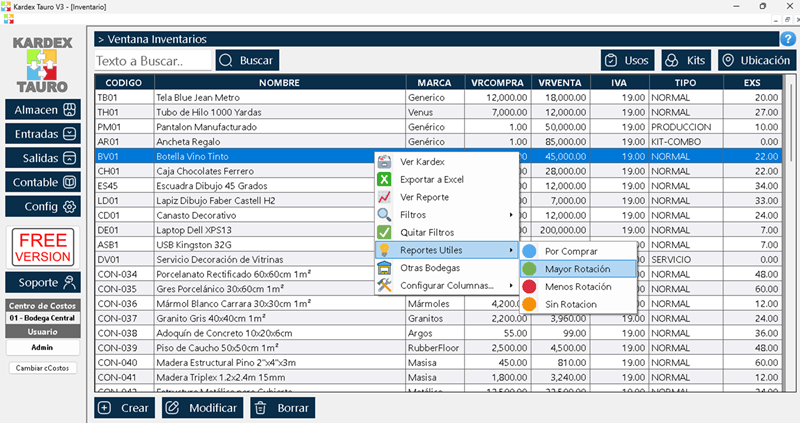
At that point a system such as Kardex Tauro is worth it, because the entry is born from the document that originates it — a purchase invoice, a sales invoice or a cash receipt — and the general journal becomes a by-product of the operation instead of a separate task. With Kardex Tauro the totals and the balance update while you work, and the template remains useful for reviewing a single period or rebuilding an old month.
Download the template, save it under the business name and record the first entry today. With the record balanced from the start, the figures that come out of it — the ledger, the trial balance, the financial statements — will hold up without surprises.
⬇ Download the template (Excel .xlsx)