Study guide template for Word

Study guide template for Word
The night before an exam, most students do the same thing: they open the notebook at page one and read it again from the top. After an hour they are tired, after two they remember half of it, and by the end the topics have blurred into each other. That is not a lack of effort. Reading is not studying. Studying means deciding first what matters, what will be asked, and in what order to review it.
A study guide is that decision written down. It turns a pile of notes, handouts and loose chapters into a short route, where the heaviest topic comes first and the secondary ones wait at the end. You build it once and use it many times: in the days before the exam it works as a review schedule, and on the last day it works as a fast recap, the one you read standing by the classroom door.
This study guide template for Word is made for high school, college and university students who need to put one subject in order, and for teachers who hand their class the review plan for a whole unit. The pages are editable, with no hidden formulas and no passwords: open them in Word, fill them in with the keyboard and print them to paste into the notebook or leave on the desk.
⬇ Download study guide (.docx)What it is and what it is for
A study guide does not replace the notebook, the summary or the textbook: it orders them and gives them dates. Its real value is in what it forces you to decide before you sit down to study.
- It cuts the course material down to the topics that will actually be on the exam, instead of reviewing the whole year just in case.
- It sets an order by importance, so the heaviest topic does not always end up last, when there is no energy left for it.
- It turns each topic into short definitions and formulas that can be read and recalled at a glance.
- It forces you to practise with your own questions before the exam, rather than discovering the question format on the day.
- It spreads the review across the days before, instead of packing it into a single sleepless night.
- It leaves a self-assessment per topic, so you know honestly what is ready and what is not.
What the template includes
The template has nine blocks and you fill them in that order, from top to bottom. The table summarises what goes into each one:
| Section | What you write |
|---|---|
| 1 · Guide details | Subject, unit or topic, teacher, class, and the exact exam date. |
| 2 · What you must know by the end | The learning outcomes of the unit, written as sentences you can actually check once the review is over. |
| 3 · Topic list by importance | The topics ordered from heaviest to lightest, with a mark for the ones already mastered and another for the pending ones. |
| 4 · Definitions and formulas | Key concepts one line each, and formulas with the meaning of every symbol and its unit. |
| 5 · Practice questions | Your own questions, multiple choice, open and applied, with blank space to answer without looking. |
| 6 · Common mistakes | The slips that keep happening in that subject and the fix for each one, written as a reminder. |
| 7 · Plan for the days before | Which topic you review each day, for how long, and what result you expect by the end of the session. |
| 8 · Self-assessment | The mark the student gives each topic, before and after the review, with the reason for every change. |
| 9 · Control and signatures | The document version table, with code, date and who checked it, and the sign-off signatures. |
How to use it step by step
Filling it in takes one afternoon the first time and a few minutes afterwards. Keep to the order, because each block builds on the previous one.
- Download the file and open it in Word. Save a copy named after the subject and the date, and keep the original clean for the next unit.
- Complete the guide details block: subject, unit, teacher, class and the exact exam date. Without that date, the review has nothing to hang from.
- Write block 2, what you must know by the end. Use sentences you can check: solve first-degree equations, not understand algebra.
- Move the topic list to the importance table and sort it from heaviest to lightest. Mark the topics already mastered, so you do not spend the best hours of the day on them.
- Fill in the definitions and formulas column with the material closed, from memory. Whatever does not come out, go back to the notes and add it afterwards; that list is the real homework for the week.
- Write between five and ten practice questions per topic and answer them without looking at the notes. Mark the exact mistake, not just that it was wrong.
- Spread the review across the days left before the exam, using block 7. Two short sessions apart work better than one long one at dawn.
- Before printing or sending the document, change the institution name in the footer and update the document code in the control table, with the version date.
Common mistakes
Most guides that get abandoned halfway fail for the same reasons. It is worth checking them before you start:
- Copying the textbook index as it is, without sorting by importance. The result is a long list that does not say where to begin.
- Writing the goals with vague verbs that cannot be checked on exam day and do not help measure progress.
- Filling in definitions and formulas with the material open beside you. That guide reads beautifully and is useless for studying.
- Practising only with memory questions and leaving out the applied ones, which are usually the ones that carry the most weight.
- Cramming the whole review into the last night, when there is no time left to go back to what did not come out.
- Leaving the footer and the control table as they came, with another institution name or an old code that no longer applies.
How to adapt it to different subjects
The same sheet works for very different subjects, but the weight of each block changes. In a subject with formulas, block 4 carries most of the value and should be filled in first. In history or literature, the topic list and the connections between events matter more than any formula. When the exam is practical, the practice questions move to the centre and the definitions shrink to a glossary you check only when something fails.
- Science and maths: one line per formula, with the meaning and unit of each symbol, and a worked example beside it.
- History and social studies: a short chain of causes and consequences per topic, with the dates that hold the sequence together.
- Languages: a column of structures and vocabulary per topic, plus five sentences written from scratch to test them.
- Practical or lab subjects: the steps of the procedure in order, with the result you expect and the safety point to watch.
How to review with the guide
A study guide used badly becomes just another sheet to read under your breath, and nothing sticks. To make it work, the review has to force you to recall without looking. These habits can be applied from day one, and they ask for nothing more than the printed sheet and a clock in sight:
- Read the definitions and formulas block, close the sheet and say the idea out loud; only then check what you missed and write it down again.
- Answer the practice questions with the timer running, to get used to the real length of the exam and to deciding fast.
- Go back every day to the topic that scored low in the self-assessment, even if you have already covered it once and think you know it.
- Explain a full topic to another person with no material at hand; if you cannot explain it without looking, it is not ready yet.
- Note at the end of each session what you understood better than the day before, so you know the method is working and can adjust the rest.
None of these habits takes time away: it moves time to a better place. Half an hour of active review leaves more behind than two hours of passive reading, and the guide exists precisely so that change is possible.
When it is worth moving to a system
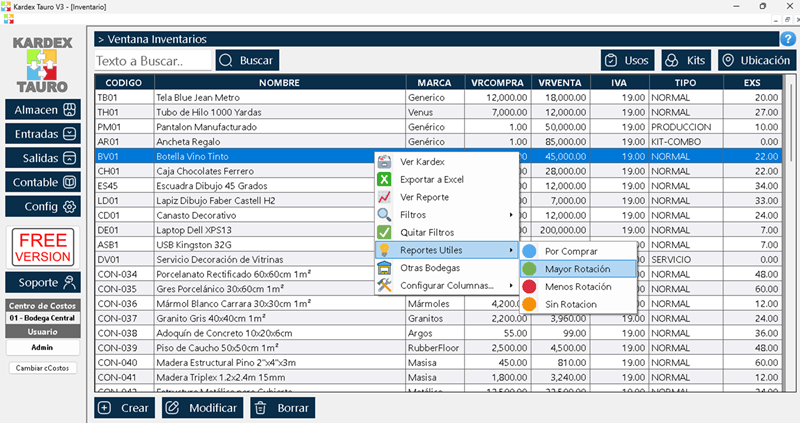
A Word study guide handles one subject and one exam very well. When the same person is carrying six or eight courses per term, or when a teacher has to deliver the review plan for a whole year, the file starts to fall short: versions multiply, nobody knows which one is current, and the progress of each topic is scattered across different folders. At that point it makes more sense to track it in a system that keeps the history and shows the state of every subject without opening file after file. Kardex Tauro points at exactly that: bringing the academic record together in one place so the control does not depend on the memory of whoever filled in the sheet. For a single subject and a fixed exam date, though, the Word template remains the most direct and the cheapest route.
This template is part of the index of Word templates, which gathers them grouped by family.
⬇ Download study guide (.docx)