Inventory counting: a guide to staying accurate

Inventory counting: a guide to staying accurate
Inventory counting is the thermometer of your business. Everything recorded in the stock ledger — inbound movements, sales, returns, shrinkage — is just an opinion until someone counts what is actually on the shelf and compares it with what the system says. Without counts, figures can look perfect on paper while being far from reality in the warehouse, and no report will warn you in time. This guide brings together what has been published on this blog about counting and reconciling: how to organize a physical count, when a cycle count makes sense, when to make an adjustment and how to measure accuracy so your inventory does not drift out of balance again. Each section links to the article where the topic is explained in full.
Physical counting: how to organize and run it
A physical count means verifying, item by item, the actual quantity of merchandise available and writing it down without looking at the records. It is a discipline: you count what is there, not what should be there. Before opening the warehouse, it is worth reading how to organize a physical inventory count, an article that walks through the full preparation: dividing the storage area into zones, printing blank count sheets, pairing counters (one counts and the other records) and deciding the unit of measure in advance so boxes, packages and loose units do not get mixed up.
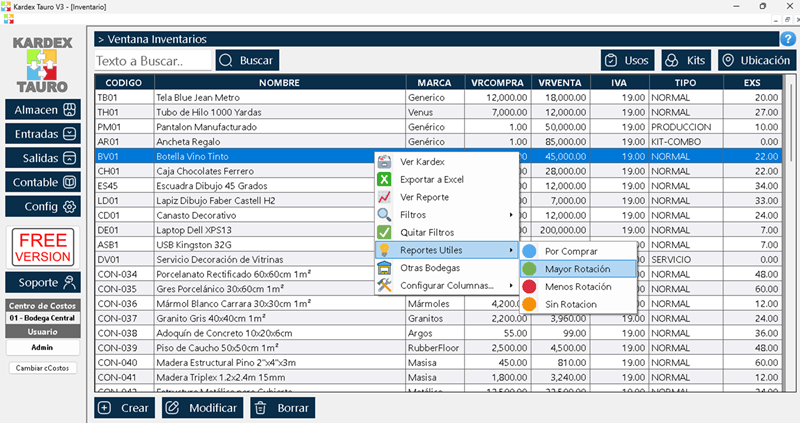
A count becomes useful when it is compared against the records. The relationship between physical count and kardex is covered in depth in its own article: the stock ledger says how much should be there according to the movements recorded, and the count sheet says how much is actually there; the differences that deserve investigation come out of that comparison. When the records live in a program like Kardex Tauro, the comparison is made against the digital stock ledger and discrepancies are caught the same day.
Many small businesses believe that counting means closing the shop and spending a full day on the task. That is not true: a short daily routine keeps inventory current without interrupting sales. The article on the 15 daily minutes that keep an inventory real shows how to review each day the shipments of the shift, compare what was delivered with what was recorded and fix small discrepancies before they grow. Fifteen minutes of review save a whole weekend of reconciliation later.
Execution has its own traps: counting from memory, skipping aisles, rounding quantities or failing to mark what has already been counted are classic mistakes that turn a count into wasted time. The guide to avoiding mistakes when counting inventory gathers the practical rules: mark every location when you finish, count twice the items with discrepancies, always use the same sheet and never trust the supposedly known quantity of a product.
Cycle counting: accuracy without closing the warehouse
A full physical count makes sense once or twice a year, but in a business with hundreds of items it is expensive, slow and exhausting, and its effect fades within a few weeks if errors keep happening. Cycle counting solves that: instead of counting everything at once, you count a group of items every week or every month on a planned rotation. The most common method is cycle counting with an ABC plan, which classifies products by value or movement: A items are counted more often, B items from time to time and C items with lower priority.
The great advantage of cycle counting is that it does not stop operations. The article on cycle counts without closing the warehouse explains how to build counting into the staff routine: each week, every person in charge receives the list of items to verify together with their count sheet, and the task is done during slow hours. That way accuracy is built continuously and the annual inventory stops being a surprise.
When to adjust inventory
A count does not adjust anything by itself: adjusting is an administrative decision that must be made with judgment. The article on when to make an inventory adjustment recommends adjusting only after confirming the difference with a second count or a review of the movements, and always with a clear reason: shrinkage, theft, recording error or damage. An adjustment without a documented cause only hides the problem and turns the stock ledger into a number that has been forced to fit.
There is one case that cannot wait: negative stock. If the system shows that you sold ten units of a product whose receipt was never recorded, the balance went negative and every new sale makes the figure worse. The article on negative stock: what it means and how to fix it walks through the steps to untangle the problem: look for unrecorded receipts, search for purchases with the wrong date and correct the movement that started the discrepancy before thinking about an adjustment.
Accuracy: measuring it and understanding why it is lost
Accuracy is the percentage of items whose count matches the records. It is not an opinion: it is measured. The article on the inventory accuracy indicator explains the formula (items that match divided by items verified) and how often to measure it. A good starting target is 95 percent or higher; below that, purchasing decisions are made on false data and the business overbuys or runs out of product.
When accuracy drops, the question is not how much is missing but why the inventory does not add up. The article that investigates why your inventory does not add up lists the causes that repeat in most businesses: receiving that signs without verifying, sales that are never recorded, misplaced products that look missing, units that get mixed and returns that never go back into the system. Almost always the discrepancy is born in a process, not in a number.
| Typical cause | What it causes | How to prevent it |
|---|---|---|
| Receiving without counting | Shortages from the start | Verify against the purchase order |
| Selling without recording | Balance higher than real | Record every exit as it happens |
| Wrong location | False shortages | Fixed, labeled locations |
| Mixing units | Counts that cannot match | One unit per count sheet |
Structural correction is worth more than a one-off adjustment. The article on how to reduce errors in a warehouse proposes attacking the root causes: fixed locations, labeled racks, limiting who receives and dispatches, and reviewing the day's movements before closing. Every error avoided is a discrepancy you will not have to chase in the next count.
The routine that keeps inventory balanced
With those pieces in place, the full routine comes together, and it is worth repeating it always in the same order. First, count by zones using blank sheets and without looking at the records. Second, compare every result against the stock ledger and list the differences. Third, investigate: recount doubtful items, review the movements of the past few days and look for the cause in the processes, not only in the quantities. Fourth, adjust only what has been confirmed, with a reason, a date and the person responsible. Fifth, record the adjustment in the stock ledger the same day and measure accuracy to know whether the routine is working. That sequence — count, investigate, adjust — separates businesses that balance their inventory from those that simply update their opinion.
It is worth saying this honestly: no program replaces the moment when a person counts the merchandise. Kardex Tauro does not count for you; what it does is keep the records current, with every movement recorded, so the count is reconciled against a reliable figure and the adjustment stays documented. To see the whole cycle, from recording movements to the metrics that watch over it, I recommend the complete guide to inventory control for small businesses, where all the topics of the blog are arranged as a single method.
Keep reading
- How to organize a physical inventory count
- physical count and kardex
- The 15 daily minutes that keep an inventory real
- How to avoid mistakes when counting
- Cycle counting with an ABC plan
- Cycle counts without closing the warehouse
- When to make an inventory adjustment
- How to fix negative stock
- The inventory accuracy indicator
- Why inventory does not add up
- How to reduce warehouse errors