Inventory control: the complete guide for small businesses

Inventory control: the complete guide for small businesses
Inventory control is the set of practices that let a business know, at all times, what merchandise it has, what it is worth and what is moving. It sounds administrative, but in practice it is the difference between a business that knows how much it earns and one that discovers its losses at the December count. This guide brings together, in one place, the concepts and methods every small business needs: from the basic definitions to the advanced metrics, with links to the articles where each topic is explained in depth.
What inventory control is and why it matters
Before applying any method, it helps to understand what is being controlled. An inventory is the valued list of merchandise available for sale or consumption: read what inventory is for the full definition and its types. Control is then applied on top of that list: recording every inbound and outbound movement so what the paper says matches what is on the shelf. The foundation is stock control and how to apply it, which explains how to track quantities day by day, and the concept of stock control levels, which adds the view of minimum and maximum quantities.
The recording system: periodic or perpetual
There are two main ways of keeping track of merchandise. The periodic system counts inventory from time to time and calculates by difference; the perpetual system records every movement as it happens. The full comparison is in perpetual inventory vs periodic inventory; for a small business with daily invoicing, perpetual is almost always the right choice, because any error is spotted the same day instead of at month end.
The stock ledger: the heart of control
In the perpetual system, the central instrument is the stock ledger: the card or record that accumulates, product by product, all inbound and outbound movements with their cost. If the concept is still unclear, start with what is a kardex and continue with the practical guide on how to make a kardex. The stock ledger does not only say how much you have: it says how much each sold unit cost, and that figure feeds the cost of goods sold and your profit directly.
Valuation methods: how much what you sell is worth
When purchase prices change, the cost of what you sell depends on the method used to value outbound movements. The explanation with worked examples is in inventory valuation methods: average, FIFO and LIFO. Choosing the method well is not an accounting whim: it changes reported profit, inventory value and, in many countries, taxes.
The metrics to watch
Controlling is not only recording: it is reading the numbers to make decisions. Four indicators summarize the health of a small business inventory. Inventory turnover says how many times a year merchandise is sold and replenished; inventory coverage says how many days of sales the warehouse stock will cover; the inventory accuracy indicator measures how reliable the record is against reality; and the concept of stockout warns about the cost of running out of product exactly when it sells the most.
Counting: how to keep the truth
No matter how disciplined the record, reality always drifts a little: shrinkage, entry errors, petty theft. That is why physical counts exist. The guide on how to organize a physical inventory count explains the traditional process without stopping the business, and the article on ABC cycle counting shows the modern alternative: counting in parts all year long, prioritizing the products that matter most. When numbers do not add up, the article why your inventory does not add up helps find the cause before adjusting blindly.
Excel or an inventory program?
Many small businesses start with a spreadsheet and it works for a while. The honest comparison between both options is in inventory program vs Excel, with the signs that the spreadsheet is no longer enough. If you are at the tool-selection stage, the top 10 inventory programs for small businesses offers an objective comparison of options for different budgets and business models.
A five-step action plan
- 1. Clean up your catalog: one code and one name per product, with its unit of measure.
- 2. Record every movement: each purchase, sale, return, shrinkage or adjustment, the same day.
- 3. Set levels: minimum stock, reorder point and purchase quantities per product.
- 4. Measure every month: turnover, coverage and accuracy, using the indicators in this guide.
- 5. Count by cycles: an ABC counting plan so the truth on paper matches the truth on the shelf.
And Kardex Tauro, our software
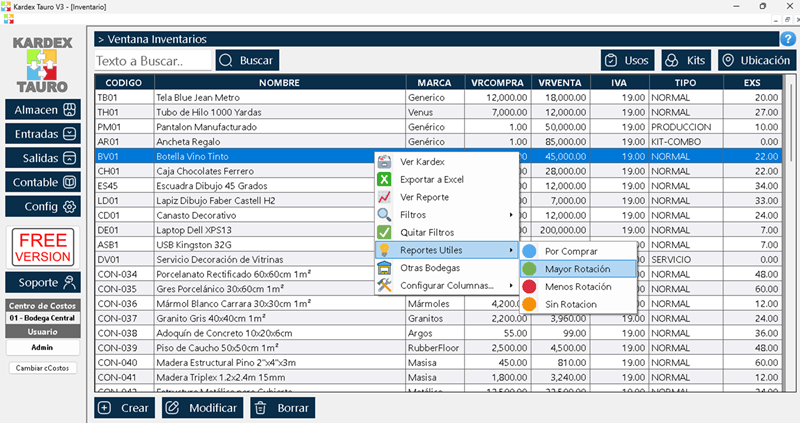
This guide lives on the blog of Kardex Tauro, an inventory and stock ledger software with integrated invoicing, designed for small businesses: it records every inbound and outbound movement, updates the cost with the method you choose and discounts stock automatically when you finalize an invoice. If you want to see all of this in practice after finishing the guide, you can try the program: it has a free plan and a full version with an annual payment per computer.
Bookmark this page as your inventory control index: every linked article goes deeper into one topic. Start where it hurts most today: if things do not add up, go to counting; if you run out of stock, go to metrics; if you do not know how much you earn, go to the stock ledger.
Recommended reading by topic
- Definitions: what inventory is and what stock control is.
- Stock ledger and valuation: what is a kardex, how to make a kardex and inventory valuation methods.
- Metrics: how to improve inventory turnover, how to calculate coverage, the accuracy indicator and what a stockout is.
- Counting: how to organize a physical count, ABC cycle counting and why your inventory does not add up.
- Tools: inventory program vs Excel and top 10 inventory programs for small businesses.
When manual control is no longer enough, the next step is inventory software: it records each movement once and keeps the balance current without copying figures by hand.