Inventory software: a guide to choosing the right one

Inventory software: a guide to choosing the right one
Choosing inventory software is one of those decisions many small businesses make on impulse: an advertising campaign, an enthusiastic review or a launch discount is enough to sign a one-year contract. The usual outcome is a program nobody uses, or one that solves problems that did not hurt while leaving the real ones untouched. This guide is designed to avoid that ending: it brings together, in one place, the decision articles this blog has published about inventory software, organized as a buying process, so you can compare with objective criteria —method, deployment model, sector and cost— before spending money. Read it in order or jump to the section that fits your case: each one links to the full article where the topic is covered in depth.
First, the method: spreadsheet or software? And for what?
The first decision is not which brand to buy, but whether you need to buy anything at all. Millions of small businesses track their merchandise in spreadsheets for years, and often that tool is enough. The question is when it stops being enough: when typing errors keep repeating, when nobody knows which file is the current one, or when the inventory never matches what is actually on the shelf. The article inventory program vs Excel compares both options against those symptoms: recording time, likelihood of error, traceability of every movement and the real cost of each alternative.
Assuming you have confirmed that you need a dedicated tool, the second filter is scope: not every business requires the same kind of program. A neighborhood store, a business with several points of sale and a distributor with a warehouse have different needs, and buying an oversized system is as expensive as buying an insufficient one. The guide what inventory software does a store need walks through, function by function, what a retail business actually uses and what is almost always unnecessary.
With the scope defined, it is time to structure the comparison between candidates. Our article how to choose the best inventory software proposes an evaluation method with weighted criteria and scores, so you can compare options with a table instead of demo impressions. It is the recommended starting point before asking for any quote.
Models and deployment: cloud, local, POS and ERP
The second group of decisions is about architecture. The question that splits the market is where the program lives and where your data is stored. Local software is installed on your computers or on your own server and runs inside your network; cloud software is used from the browser and keeps the information on the provider's servers. Neither model is superior in the abstract: the answer depends on your connectivity, the number of points of sale, your budget and your tolerance for risk. The balanced analysis of both sides is in cloud inventory software vs local software.
If your operation depends on checking stock from several places, or if you want to avoid installations and manual backups, the article cloud inventory software explains how the model works, what happens when the connection fails and in which cases a monthly subscription makes sense.
It also helps to separate two tools that are often confused: the point of sale records sales, payments and cash register shifts, while inventory software controls stock, costs and merchandise movements. Many businesses buy one believing they are getting the other. The guide point of sale POS vs inventory software explains when a POS is enough, when an inventory program is enough and when you need both working together as an integrated pair.
And if your business already runs purchasing, sales, accounting and inventory in separate systems, the next technical step is an ERP. Before letting the word impress you, it is worth reading what an ERP is and when your business needs one, which clearly defines from what size of operation an ERP justifies its complexity and cost.
To help you decide between the two main models, this table compares the points that weigh most in the decision:
| Criterion | Local software | Cloud software |
|---|---|---|
| Internet connection | Works offline inside your network | Requires a stable connection |
| Installation | Installed on each computer or server | Used from the browser, no installation |
| Where data lives | On your own equipment | On the provider's servers |
| Typical cost | License or yearly payment per machine | Monthly or yearly subscription |
| Several points of sale | More complex synchronization | Centralized, real-time information |
Regional context: SMEs in Colombia
Local context matters more than it seems when choosing software. Electronic invoicing requirements, the most common payment methods, the quality of support during your business hours and even how providers charge can change how convenient each option is. That is why buyers who rely only on international reviews usually get unpleasant surprises. For those operating in that country, the article inventory software for SMEs in Colombia reviews the local criteria worth verifying —fiscal requirements, support in Spanish, payment methods and real costs— before making a decision.
Our comparison articles: a top 10 for every priority
With the method and the model clear, it is time to look at concrete options. This blog publishes top-10 style comparisons built from public information and presented in alphabetical order, without declaring winners: the purpose is for you to decide using an objective feature table, not for someone else to decide for you. Those lists also include Kardex Tauro, the software we develop ourselves, identified for transparency and given no special treatment.
Where to start depends on your priority. For a general view of the market, begin with the top 10 inventory programs for small businesses. If, on top of controlling stock, you need to invoice from the same system, the selection changes completely: check the top 10 inventory programs with invoicing. If you still hesitate between architectures, the local vs cloud top 10 comparison groups the options of each side and makes direct comparison easier.
There are also comparisons for specific sectors and needs: the top 10 programs for hardware stores, designed for product lines with thousands of references and sizes; the top 10 programs for pharmacies, where batch and expiry control is non-negotiable; the top 10 programs with barcode support for those who want to speed up entries, exits and counts with scanners; and the top 10 programs with a free plan, trial or one-time payment for those who need to start without tying up their cash flow.
Closing: your selection checklist
Before signing any contract, go through this checklist with each candidate. If a program fails on more than two points, it is probably not the right one:
- Deployment: local, cloud or hybrid? Does your connectivity, your equipment and your points of sale support it?
- Local invoicing: if you invoice in your country, does the program meet the electronic invoicing requirements where you sell?
- Three-year cost: add up licenses, renewals, support, updates and training. The price of the first month is almost never the real cost.
- Support and provider: what happens the day it fails? Is there support in your language, during your hours and with reasonable response times?
- Your data: can you export it whenever you want? What happens to your historical information if you cancel or switch providers?
A final piece of advice: test before you pay. Almost every program offers a free plan or a trial period; use it with your real products, not with sample data, and record a full week of operations. That test will tell you more than any review.
Transparency about the software we develop
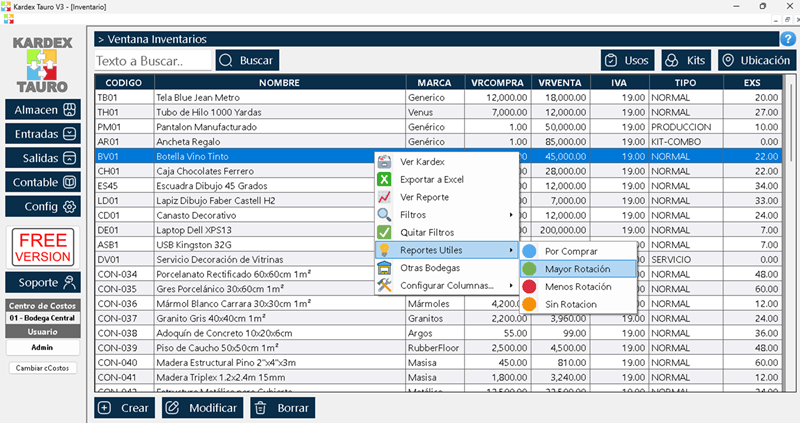
To be clear: Kardex Tauro is the inventory software with integrated invoicing that we develop and promote from this blog, so this guide is not a neutral industry review but a map of criteria for you to compare with your own numbers. That is why we deliberately avoid declaring a winner and prefer to give you tools to evaluate. If you want to validate these criteria with a real case, you can put Kardex Tauro to the test with its free plan and your own merchandise. And if your goal is not only to pick a program but to set up the whole system —valuation methods, metrics, counts and daily control—, the natural next step is the complete guide to inventory control for small businesses, which organizes the entire process from start to finish.
Further reading
- Method: inventory program vs Excel, what inventory software does a store need and how to choose the best inventory software.
- Models and deployment: cloud inventory software vs local software, cloud inventory software, point of sale POS vs inventory software and what an ERP is and when your business needs one.
- Regional context: inventory software for SMEs in Colombia.
- Comparisons: top 10 best inventory programs for small businesses, top 10 inventory programs with invoicing, local vs cloud top 10 comparison, top 10 programs for hardware stores, top 10 programs for pharmacies, top 10 programs with barcode support and top 10 programs with a free plan, trial or one-time payment.
- Complete framework: complete guide to inventory control for small businesses.
